Digital Twin as a Decision Engine, Not a Prettier Model

Model versus engine
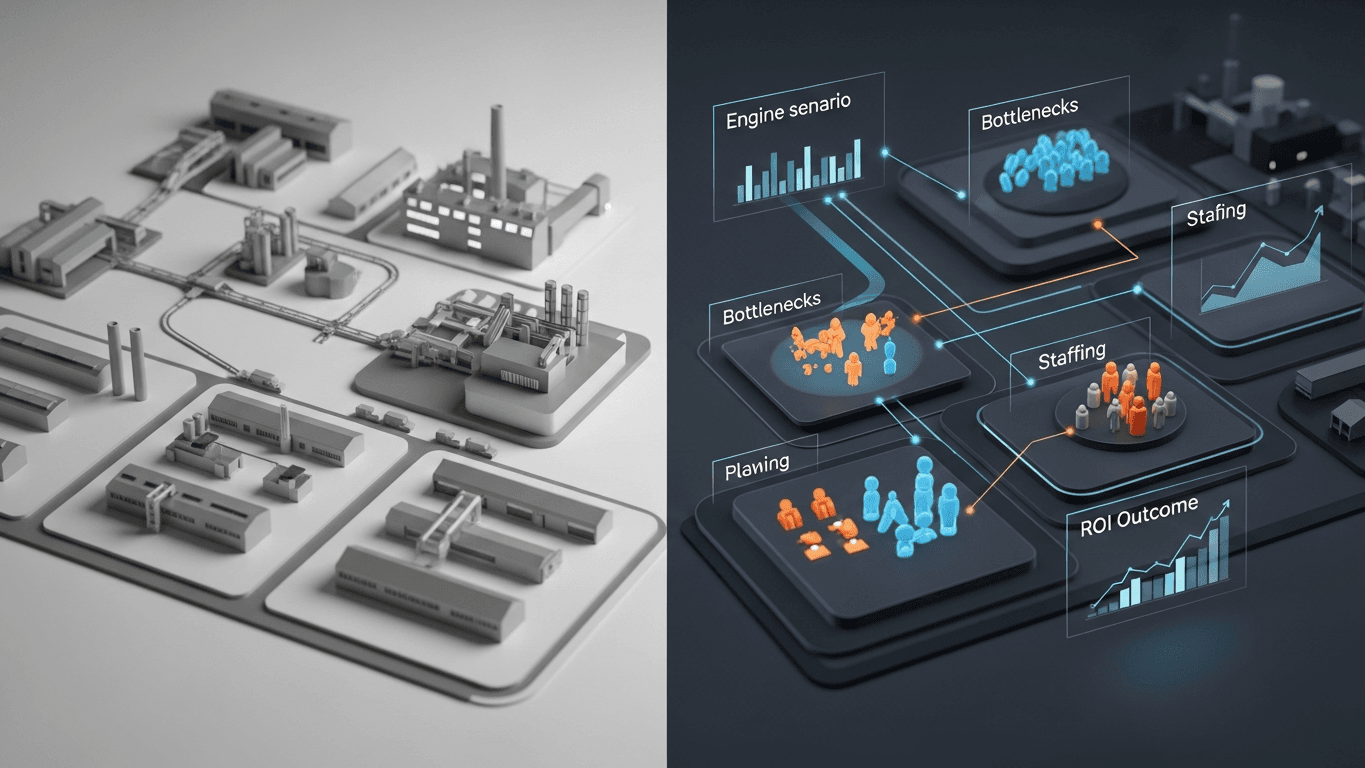
Visualization answers a comfort question: what does the space look like? A decision engine answers an accountability question: what breaks first when demand shifts, a resource slows, or buffer policy changes? That second question is where rework, delay, and weak ROI usually begin. The twin belongs in the same conversation as approval criteria—not only in engineering reviews where geometry is already settled.
What leadership actually buys
Executives rarely lose money because a factory was hard to picture. They lose money when forks are settled from static averages and confident storytelling: invest now versus stage the spend; automate versus rebalance flow first; add capacity versus remove a hidden constraint; change layout versus change scheduling or staffing rules. When those choices never share a shock vocabulary, the organization pays in redesign, ramp friction, underused equipment, and recurring arguments about what the case assumed.
Minimum logic the twin must represent
You do not need live feeds on day one to treat the twin as decision infrastructure. You need enough structure to run comparable scenarios: process sequence with cycle time ranges, not only point values; changeover, failure, and recovery stated as ranges where they move outcomes; demand or mix cases that include peak, slump, and unfavorable mix; staffing, batching, and handoff rules that match how the line is actually run. Teams that run only average demand often approve flows that fail in the first busy week. The engine’s job is to make that class of surprise visible while options are still cheap to change.
Progressive maturity without deferral
Live integration strengthens calibration over time. The first value often arrives earlier: a shared language for shocks, explicit trade-offs, and fewer silent assumptions in the approval pack. Waiting for perfect connectivity while decisions proceed on spreadsheets is how “digital twin” becomes a future program instead of a current gate. Maturity should follow the decisions that pay for it, not the other way around.
What DBR77 Digital Twin adds
DBR77 Digital Twin is built for scenario comparison and operational de-risking before execution, not for visual theater. For executive and finance audiences it keeps one question in view: which option survives disciplined stress, and what downside remains visible before signatures and spend?
Bottom line
The shift is not “do we have a twin on screen?” It is “can we test this decision before reality punishes a wrong assumption?” When that standard is met, the twin is not decoration. It is part of how capital and operations agree on what “good” means.
DBR77 Digital Twin helps leaders test scenarios, compare variants, and reduce CAPEX decision risk before making physical changes. Book a demo or Browse use cases.
Want to see Digital Twin on your scenario?
Book a short demo — we'll show the fastest path to decision-grade outcomes.