Digital Twin and CAD: Complementary Roles in Design and Approval

Design truth versus operating truth
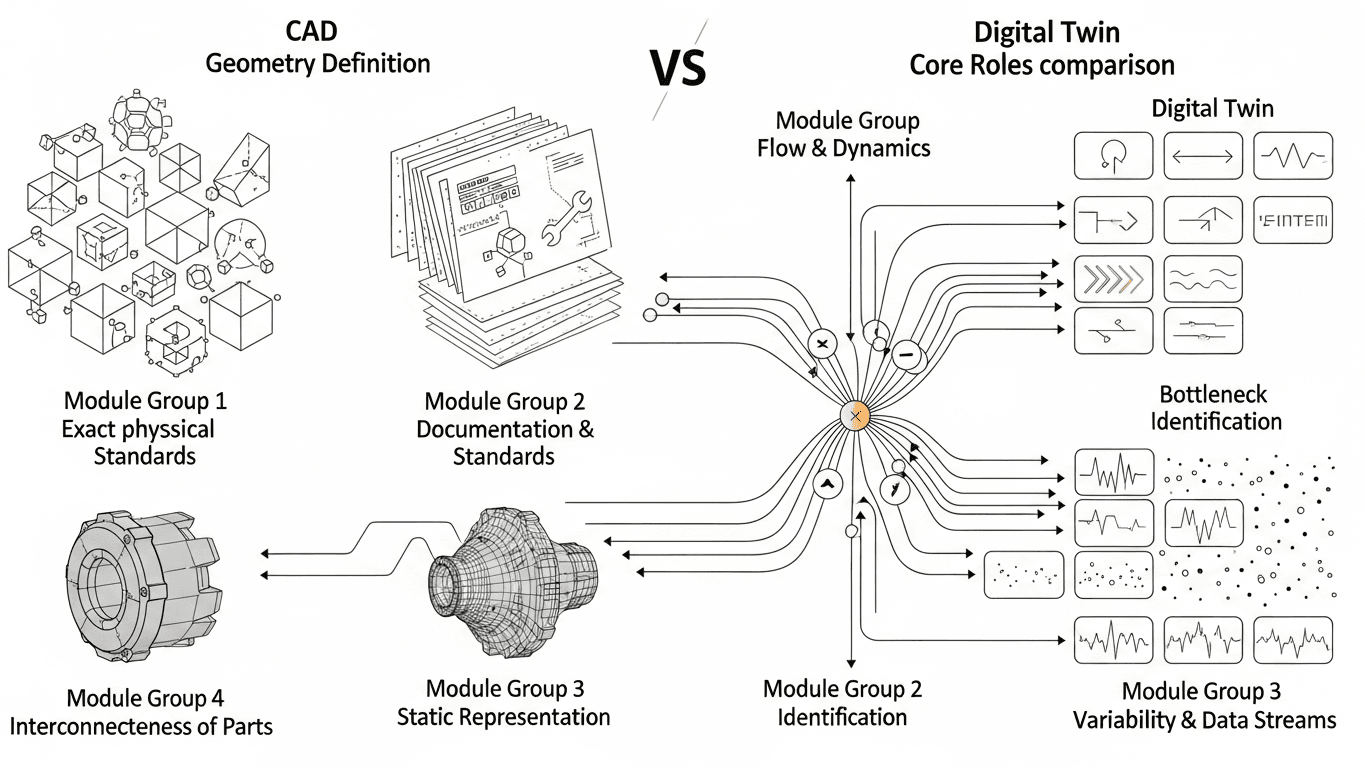
CAD is authoritative for dimensions, placement, and engineering detail. Operating performance still depends on stochastic cycle and recovery, buffer and supermarket behavior, staffing and shift effects, and transport interference—dynamics CAD is not built to adjudicate. A design can be CAD-correct and still underperform when those behaviors are ignored at the gate.
Where each tool earns its seat
At concept selection, CAD helps when space envelopes and major footprints are still open; the twin helps when options need comparable throughput, queue, or lead-time behavior. At funding gates, CAD must freeze interfaces and installation constraints enough to procure; the twin must show whether the case survives stress demand, mix, or ramp without hidden bottlenecks. In detailed design, drawings are the contract with build and safety; sensitivity on top assumptions still needs a shared shock set before release. After go-live, as-built updates belong in the design baseline; the twin supports delta scenarios when mix, staffing, or flow rules drift. If funding rests only on geometry and static ROI, behavioral risk remains unmanaged.
The cost of conflating the two
When leadership treats a twin initiative as “CAD with better rendering,” teams underfund simulation discipline, approve layout or automation before interaction effects are tested, and discover trade-offs during ramp instead of in the model. The confusion is not academic. It shows up as rework, schedule slip, and weaker confidence in the next case.
Working together in one thread
Export geometry or layout anchors from CAD into the twin where it saves time. Keep authority clear: CAD owns the design record; the twin owns comparative runs under agreed assumptions and shocks. That pairing shortens the distance from “looks right” to “behaves acceptably under the cases we are willing to sign.”
How this shows up in gate memos and floor conversations
A useful digital twin practice creates continuity between the conference room and the walk-through. Gate memos should read like operational documents: named options, shared shocks, explicit exclusions, and the guardrails that actually bound spend. The floor conversation should echo the same language—where time accumulates, where buffers sit, what changes when inbound wobbles—so engineering detail does not get "translated" into loss on the first busy week.
Layout debates especially need this bridge. Geometry is persuasive on paper; flow is persuasive under stress. When your comparison table includes intralogistics load, constraint migration, and recovery behavior—not only headline rate—you reduce the classic failure mode where the cheapest footprint buys the most fragile Tuesday. Finance should see how timing and working capital move with those choices, not only how the capex ticket compares. That alignment is how scenario work earns a permanent seat at the table instead of a one-time consulting glow.
What DBR77 Digital Twin adds
DBR77 Digital Twin sits on the decision side of that pairing: comparable scenarios, deviation-aware runs, and traceability from assumption changes to outcome shifts so sponsors see downside before commitment. For gate-heavy organizations it aligns with the rhythm of CAPEX stage reviews—one behavioral evidence bar per promotion, not a one-off render review.
Bottom line
Ask not whether the twin replaces CAD. Ask whether the approval pack still lacks behavioral evidence after the design is documented. CAD defines what you intend to build; a decision-grade twin tests how that intent performs before the factory becomes the first full-scale experiment.
DBR77 Digital Twin complements CAD by adding scenario testing, stochastic simulation, and decision-grade confidence before physical changes are approved. Book a demo or Explore Digital Twin.
Want to see Digital Twin on your scenario?
Book a short demo — we'll show the fastest path to decision-grade outcomes.