5 Scenarios Every Factory Should Simulate
Why “everything” is the wrong first scope
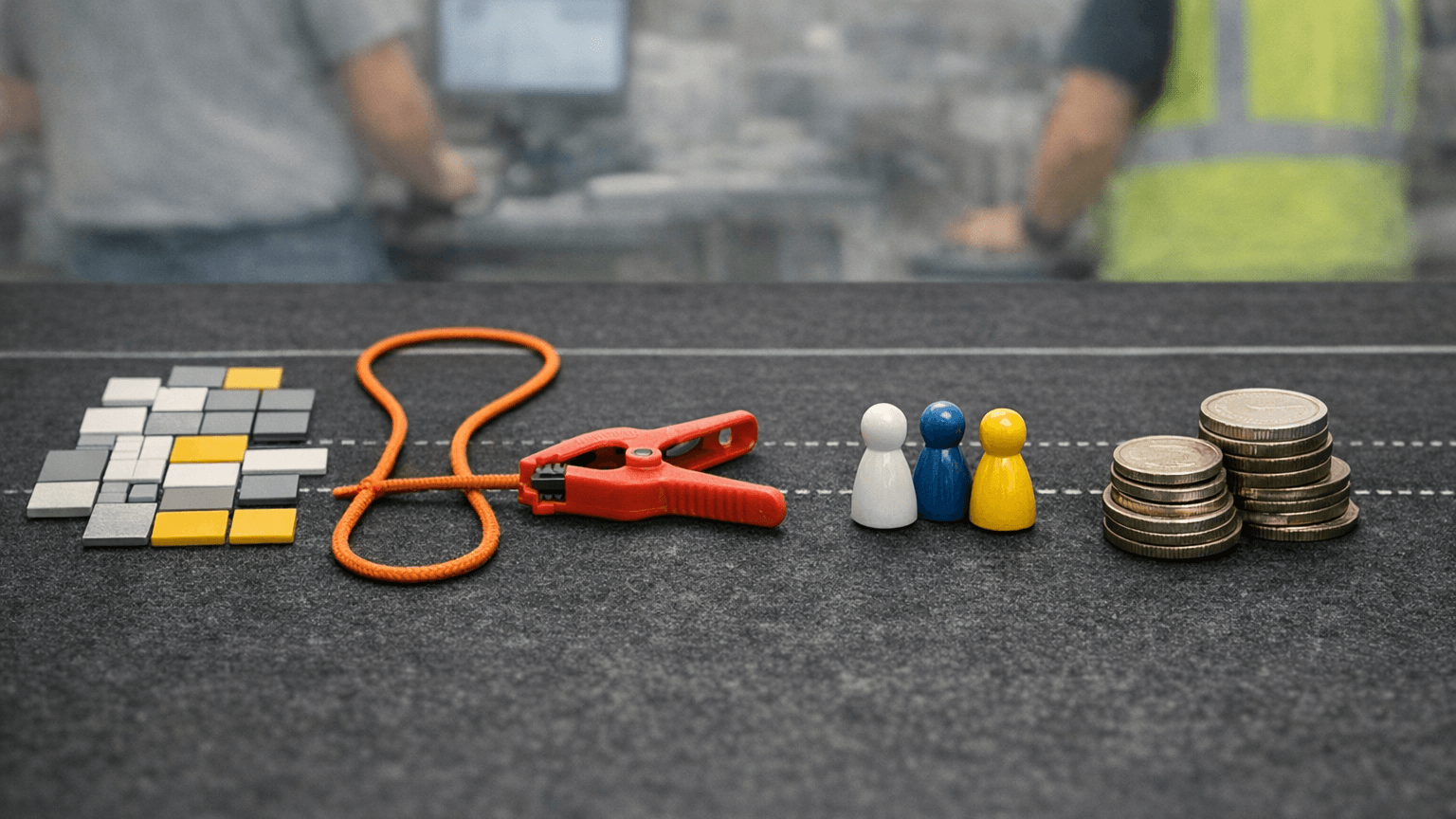
Factories do not need to simulate every detail on day one. They need to simulate decisions where wrong assumptions become expensive fastest—usually choices involving flow, layout, staffing, capacity, and capital allocation. Narrow scope accelerates learning and builds the habit of comparable runs before ambition expands.
Layout before the floor moves
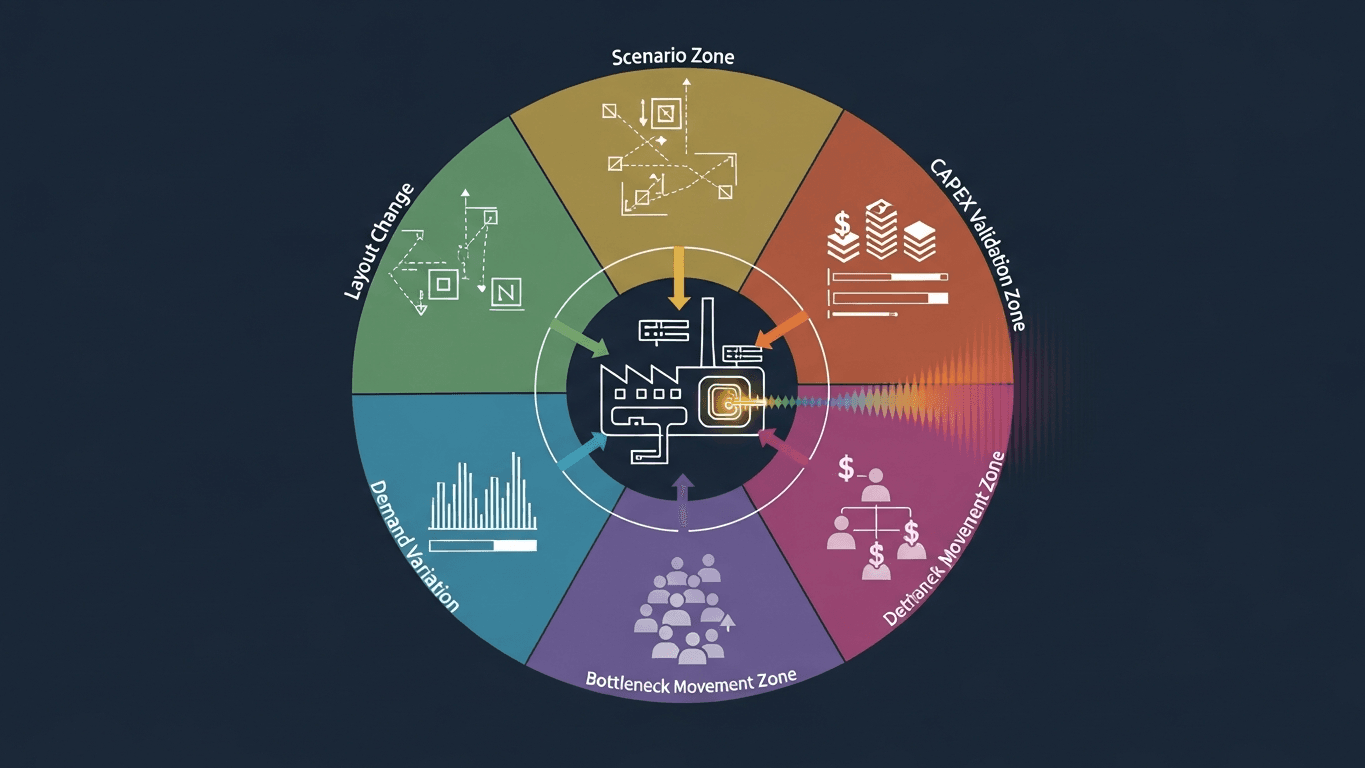
Any layout modification can create hidden effects in transport paths, congestion, queue formation, and operator movement. Physical change becomes expensive once implemented, which is why this scenario family earns priority.
Throughput under real variation
Many plans are tested only against the expected case. Factories should simulate demand rises, order mix shifts, slowed resources, and buffer behavior that diverges from the ideal. The question is robustness, not a single happy hour.
Bottleneck migration after improvement
Removing one bottleneck often relocates the constraint. Simulation helps test where the new bottleneck appears, what side effects emerge, and whether the gain survives across the whole flow. Improvement scenarios matter as much as greenfield design.
Workforce and shifts
Labor decisions strongly affect system behavior. Test staffing levels, shift pattern changes, operator allocation by area, and manual versus assisted work balance—especially when output depends on people movement and coordination, not only machine capacity.
CAPEX before signatures
Before approving a new line, station, robot, or major change, simulate expected upside, downside cases, interaction with current flow, and risk of weak utilization. Capital discussion becomes a tested path instead of a confident assumption.
What should feel different on Monday
Teams rarely fail because they lack intelligence; they fail because the next meeting repeats the same questions with fresher anxiety. When simulation work is wired into how you decide, Monday shows up with fewer circular arguments about whether a layout "ought to work." Instead, you carry a short list: which option survived the same stress vocabulary, which assumptions still carry hypothesis labels, and what would force you to rerun the pack before the next tranche. That is the practical face of governance—not a heavier process, but a clearer receipt for why the floor should trust the plan.
For capital and footprint choices, the receipt matters as much as the ranking. Approvals should be able to point to scenario identity and ranges without opening a model. If executives cannot explain the downside story in plain language, the organization is still buying animation. If operations cannot recognize the staffing and flow assumptions embedded in the memo, the twin is still a slide, not a decision system. Use the next leadership block to test whether the narrative is portable: could someone not in the room defend the choice from the packet alone? If not, tighten the assumption ledger and the executive summary before you ask for more money or more floor space.
What DBR77 Digital Twin adds
DBR77 Digital Twin keeps these scenario families inside one comparable model so layout, labor, and CAPEX discussions share behavior evidence instead of parallel slide decks: side-by-side runs with shared variability and assumptions, and a practical path from manual or historical inputs toward richer data without a day-one data program. The starter list becomes an operating habit, not a workshop souvenir.
Bottom line
Factories do not need infinite ambition to start. They need the scenarios where bad assumptions become expensive fastest. That is how simulation becomes a practical decision tool instead of an innovation side project.
DBR77 Digital Twin helps factories test the scenarios that matter most before layout, labor, throughput, and CAPEX assumptions become expensive. Book a demo or Browse use cases.
Want to see Digital Twin on your scenario?
Book a short demo — we'll show the fastest path to decision-grade outcomes.