How CFOs Can Use Simulation to Validate ROI

From argument to test
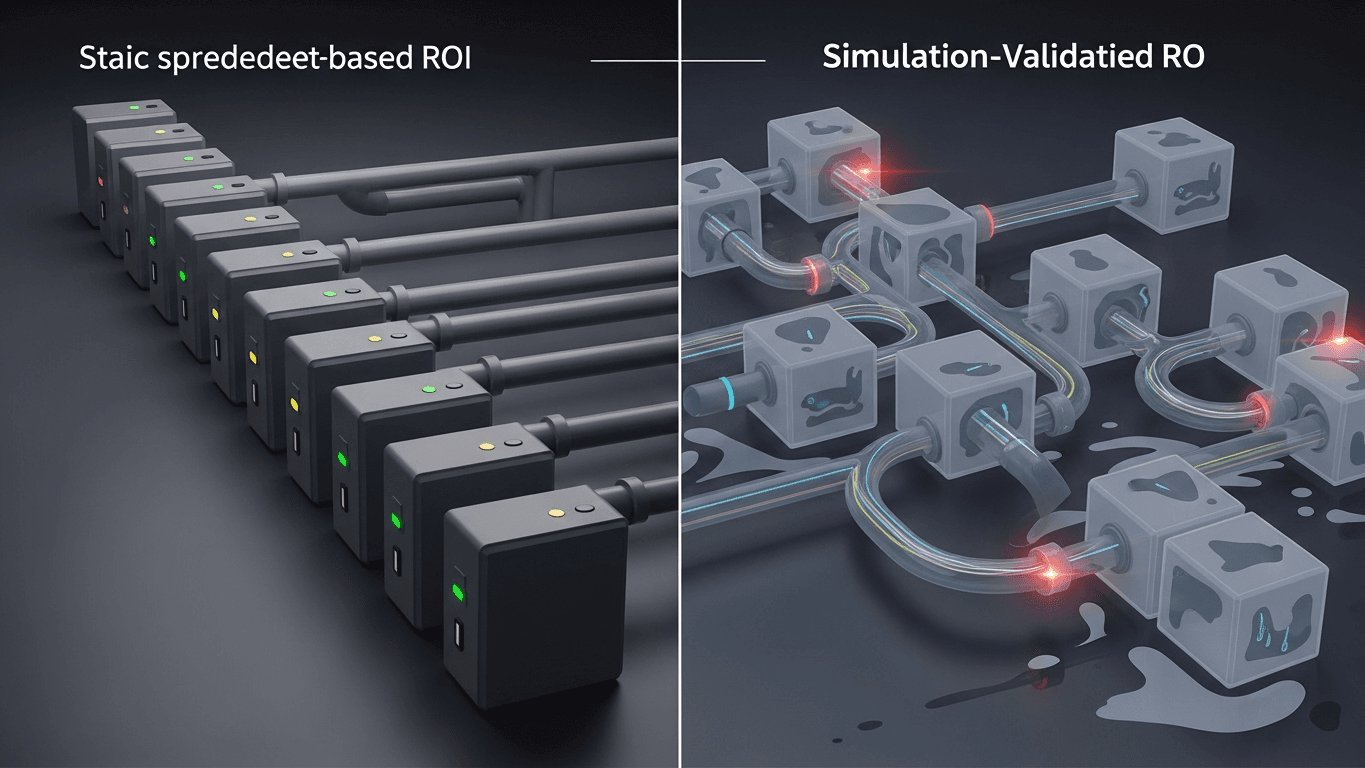
Digital twin allows finance and operations to examine the investment case together: whether throughput actually improves, whether delays shift elsewhere, whether layout constraints cap the upside, whether downside scenarios materially weaken economics. Simulation does not replace finance logic. It strengthens it by making operational dependencies explicit before signatures.
Downside visibility beats optimism
Many investment discussions skew toward the base case. Simulation improves decision quality by surfacing sensitivity, fragile assumptions, and realistic outcome ranges. The goal is not pessimism for its own sake. It is a more credible conversation before approval—one where leadership knows what has been examined and what remains exposed.
Better questions in the room
With simulation in the process, finance can move beyond “what is the expected payback?” toward “what drives the payback?”, “what could erode it?”, “which operational dependencies matter most?”, and “which scenario still holds if conditions worsen?” That shift turns approval into a discussion of mechanisms, not moods.
CAPEX governance and disciplined confidence
Capital allocation requires distinguishing a project that looks attractive from one that remains attractive after realistic scenario testing. That distinction prevents expensive overconfidence. Simulation is part of how governance earns its name.
What should feel different on Monday
Teams rarely fail because they lack intelligence; they fail because the next meeting repeats the same questions with fresher anxiety. When simulation work is wired into how you decide, Monday shows up with fewer circular arguments about whether a layout "ought to work." Instead, you carry a short list: which option survived the same stress vocabulary, which assumptions still carry hypothesis labels, and what would force you to rerun the pack before the next tranche. That is the practical face of governance—not a heavier process, but a clearer receipt for why the floor should trust the plan.
For capital and footprint choices, the receipt matters as much as the ranking. Approvals should be able to point to scenario identity and ranges without opening a model. If executives cannot explain the downside story in plain language, the organization is still buying animation. If operations cannot recognize the staffing and flow assumptions embedded in the memo, the twin is still a slide, not a decision system. Use the next leadership block to test whether the narrative is portable: could someone not in the room defend the choice from the packet alone? If not, tighten the assumption ledger and the executive summary before you ask for more money or more floor space.
What DBR77 Digital Twin adds
DBR77 Digital Twin helps CFOs and leadership evaluate ROI through scenario comparison, simulation with realistic deviations, progressive data maturity, and human-approved decisions—so finance can validate whether the business case survives real operational logic rather than only spreadsheet logic.
Bottom line
CFOs can use simulation to validate ROI by testing whether the assumptions behind the return still hold under realistic operating conditions. That does not remove uncertainty; it makes uncertainty visible enough to govern. That is what stronger capital discipline looks like.
DBR77 Digital Twin helps finance validate ROI through scenario comparison, deviation-aware simulation, and decision-grade support before CAPEX approval. Book a demo or Browse use cases.
Want to see Digital Twin on your scenario?
Book a short demo — we'll show the fastest path to decision-grade outcomes.