How Digital Twin Reduces CAPEX Risk

Risk is baked in before implementation
Many organizations treat CAPEX risk as something that appears during rollout. Much of it is created earlier: assumptions too optimistic, constraints too weakly understood, downside cases unexplored, interactions across the system left implicit. Risk becomes structural in the approval itself.
Static cases are necessary—and incomplete
Spreadsheets and presentations belong in the process. They are not operational proof. A static case can estimate payback, cost, capacity gain, and timeline. It cannot show clearly how the system behaves when conditions become less ideal—when mix shifts, recovery slows, or shared resources interfere.
Scenario discipline is capital discipline
Stronger capital decisions test more than the preferred outcome. They test higher variability, bottleneck migration, utilization under stress, and downside cases that change economics. That is how confidence becomes discipline instead of theater.
The price of false certainty
One of the largest CAPEX costs is not only a wrong decision but a decision that looked safe because it was not challenged hard enough. The bill often includes redesign after approval, underused assets, slower ramp, and internal debate over what was missed. CAPEX risk is partly a decision-method problem.
How digital twin helps
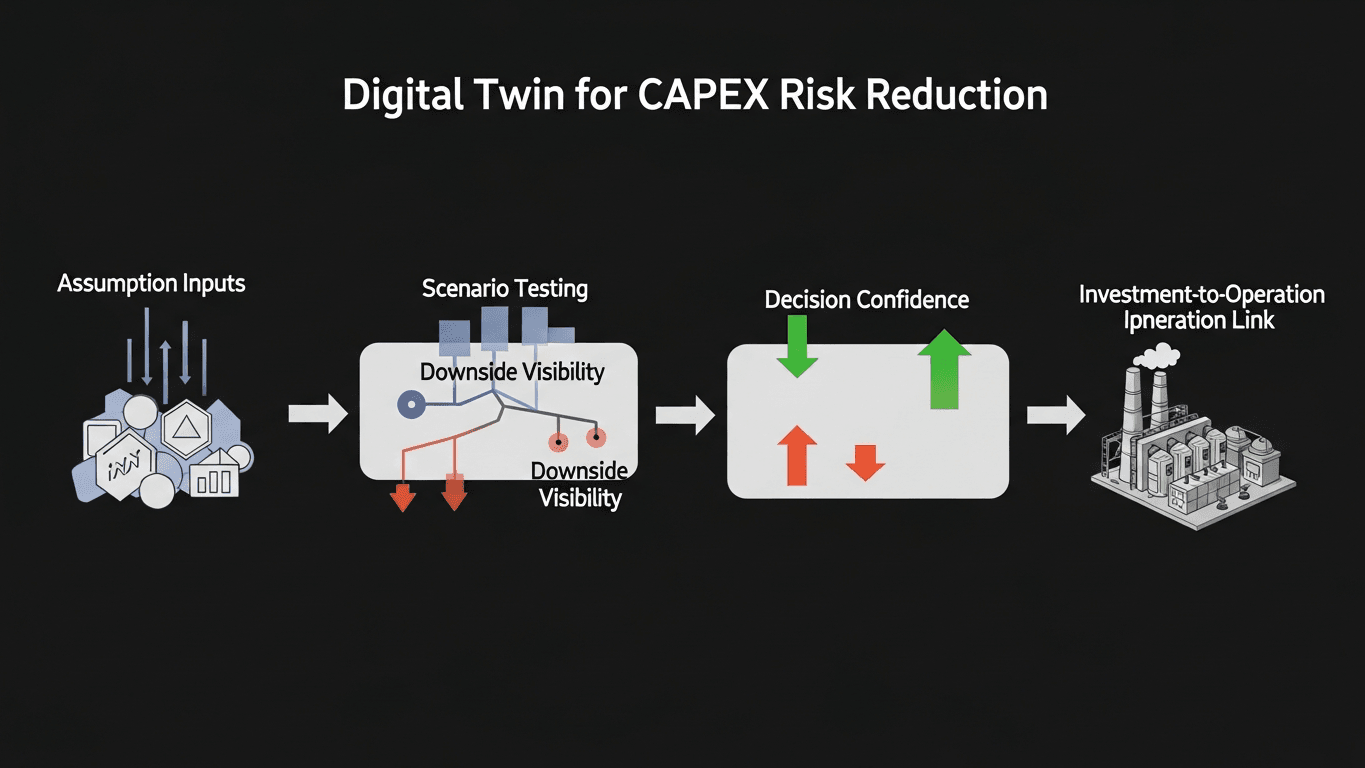
Digital twin allows teams to test investment logic before the plant absorbs the consequence: whether expected upside holds, where constraints appear under variation, what trade-offs hide in the chosen option, how robust the case remains if assumptions weaken. It does not make capital decisions easy. It makes them more defensible.
Finance and operations together
CAPEX risk cannot be governed by finance alone or engineering alone. It needs a shared model where operations can test behavior, finance can validate downside, and leadership can compare scenarios with clearer confidence. Simulation is the bridge between ambition and governance.
Executive discipline without slowing the line
The goal is not more meetings; it is fewer surprises. A disciplined twin rhythm means the expensive conversations happen early, when options are cheap, and the later forums validate decisions that already survived a standard pack. Executives should experience simulation as a narrowing machine: it retires weak paths with evidence, clarifies what must be verified before cash moves, and forces owners to name what would invalidate the plan.
Treat sensitivity and stress as part of capital hygiene, not as a specialist hobby. If a ranking flips under plausible bands, leadership should see that flip before signatures land—otherwise the organization discovers it during ramp. If a ranking is stable but fragile under disruption stories, that fragility belongs in the memo as a managed risk, not as a private worry for operations. Digital twin is strongest when it makes those tensions visible while you still have room to sequence work, stage cutovers, or adjust buffers without heroics.
What DBR77 Digital Twin adds
DBR77 Digital Twin targets fragile capital assumptions: paired upside and downside runs, utilization stress, constraint migration while redesign is still cheap. One assumption set that finance and engineering challenge together; early retirement of weak options before purchase orders harden mistakes. When your process uses formal stage gates, carry the same evidence into the gate map in the stage-gates article.
Bottom line
Digital twin reduces CAPEX risk by moving uncertainty forward into a controlled decision stage. That beats discovering weakness after approval, when redesign and delay are far more expensive.
DBR77 Digital Twin helps leadership reduce CAPEX risk by testing scenarios, constraints, and downside logic before an investment is approved. Book a demo or Browse use cases.
Want to see Digital Twin on your scenario?
Book a short demo — we'll show the fastest path to decision-grade outcomes.