How Simulation Reduces Change Risk in Production and Logistics

Plant floor: small moves, large interaction
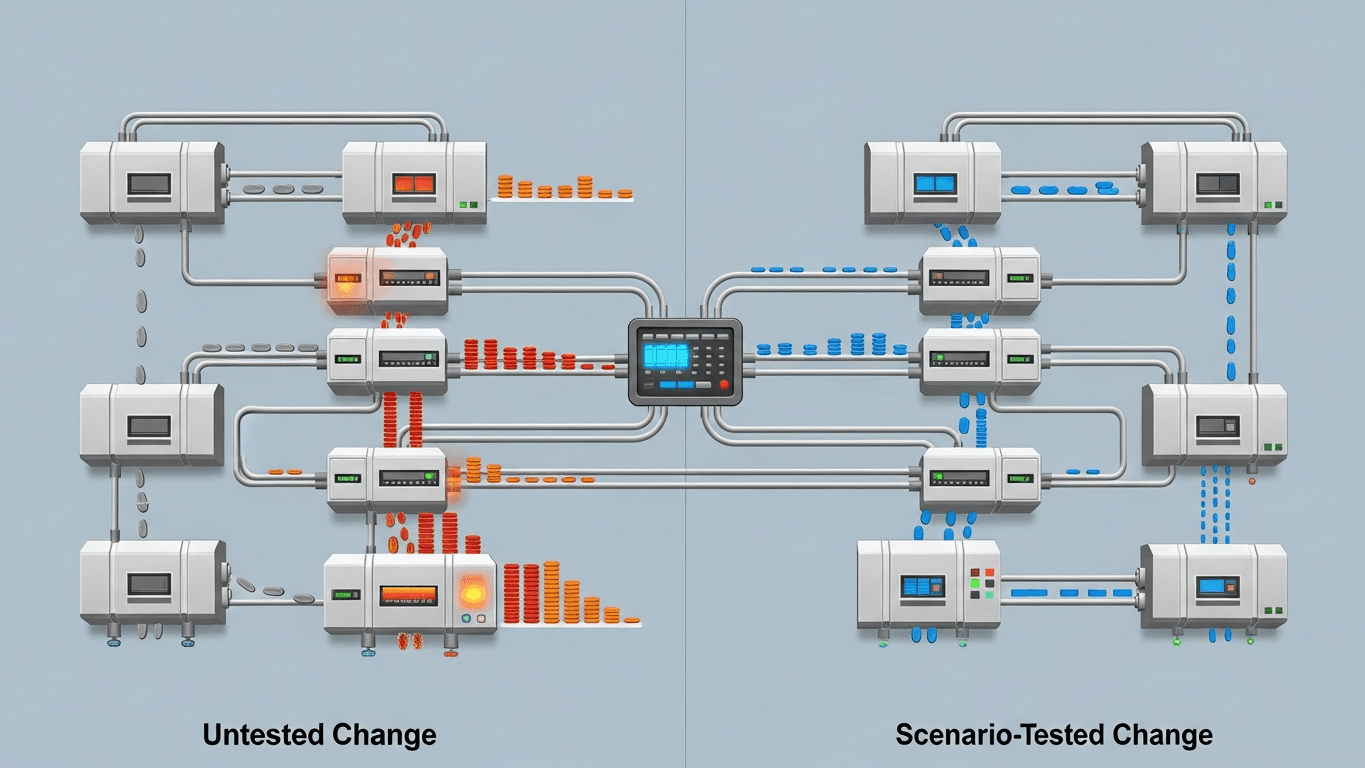
On the shop floor, “minor” relocations can starve upstream when batching logic is unchanged; buffer shrinkage can stabilize one island while destabilizing the merge feeding it; a new sequencing rule can speed one line and create conflict in a shared aisle. These patterns show up in time-based signals—queue length, starvation events, constraint utilization swings—not in static diagrams.
Warehouse and intralogistics: rhythm over map distance
Logistics changes often fail on timing and policy, not on neat lane drawings. Slotting tuned to average pick rates can break when promotional mix spikes; replenishment interval changes can push unexpected downstream waits; dock or staging policy shifts can create vehicle contention that distance math never sees. Simulation makes those rhythms visible before service levels and overtime absorb the shock.
A compact gate before go-live
Use simulation when the change touches the current bottleneck or shared buffer policy, alters merge, split, or handoff logic, or changes replenishment, staging, or pathing used under peak. Cosmetic 5S within one island with no flow rule change usually does not need the same depth. The point is proportionality with consequence.
Faster decisions, fewer circular arguments
Simulation is often accused of slowing work. In practice it shortens debate when the alternative is conflicting intuition without a common shock set. Teams align faster when they compare baseline versus proposed under the same demand cases, include downside resource availability, and rehearse a ramp week with constrained recovery. The model is not a substitute for leadership; it is a shared language for trade-offs.
Executive discipline without slowing the line
The goal is not more meetings; it is fewer surprises. A disciplined twin rhythm means the expensive conversations happen early, when options are cheap, and the later forums validate decisions that already survived a standard pack. Executives should experience simulation as a narrowing machine: it retires weak paths with evidence, clarifies what must be verified before cash moves, and forces owners to name what would invalidate the plan.
Treat sensitivity and stress as part of capital hygiene, not as a specialist hobby. If a ranking flips under plausible bands, leadership should see that flip before signatures land—otherwise the organization discovers it during ramp. If a ranking is stable but fragile under disruption stories, that fragility belongs in the memo as a managed risk, not as a private worry for operations. Digital twin is strongest when it makes those tensions visible while you still have room to sequence work, stage cutovers, or adjust buffers without heroics.
What DBR77 Digital Twin adds
DBR77 Digital Twin supports deviation-aware scenario comparison for production and logistics changes, with a path from structured manual inputs toward deeper integration so early gates still receive behavioral evidence. For mixed plant-and-warehouse programs it keeps one comparable model vocabulary instead of parallel spreadsheet stories.
Bottom line
Simulation does not remove uncertainty. It relocates uncertainty to a place where wrong assumptions are cheap. Robust operations need that relocation whenever the change can alter how the system waits, moves, or recovers.
DBR77 Digital Twin helps teams test operational changes through scenario comparison, deviation-aware simulation, and human-approved decisions before change hits reality. Book a demo or Browse use cases.
Want to see Digital Twin on your scenario?
Book a short demo — we'll show the fastest path to decision-grade outcomes.