How to Compare Layout Variants Without Guesswork

Why a convincing drawing misleads
A layout can look decisive in CAD and still underperform in motion. Performance depends on flow logic, buffers, movement paths, congestion, and how staffing interacts with sequence and batching. Static review struggles to weigh those factors together because they only fully appear when the system runs. Guesswork hides inside “reasonable” distance estimates and idealized throughput assumptions that never faced a bad week.
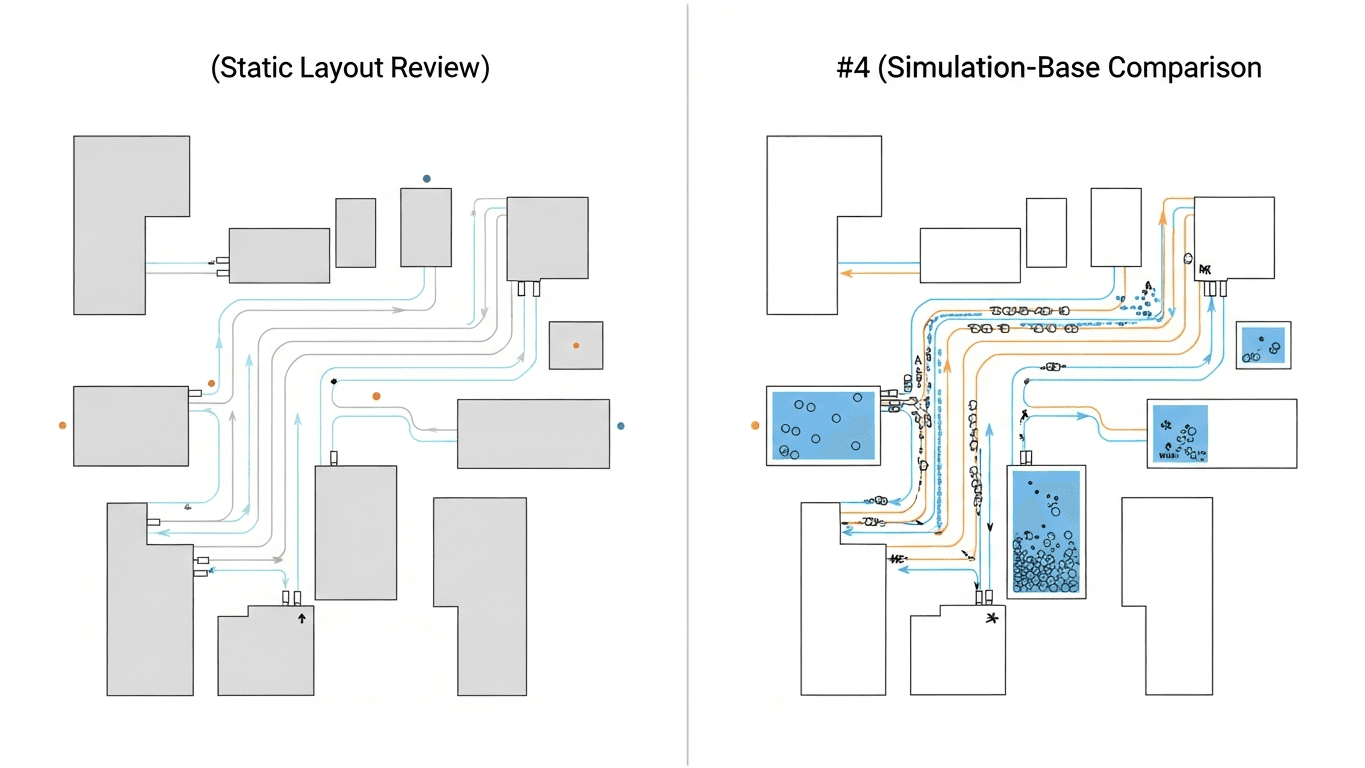
Variants belong in the same shock box
Meaningful comparison requires the same rules and the same shocks for every option. Asking only “which layout looks better?” invites opinion. Asking “which layout performs better under realistic variability, and where does waiting accumulate?” invites evidence. That shift moves design review toward decision-grade layout engineering.
Interaction effects are the silent tax
Small moves can rearrange the system: a buffer shift stabilizes one island and destabilizes a merge; a station relocation changes upstream starvation; a faster local step creates forklift conflict in a shared aisle. Geometry alone rarely predicts those outcomes. The risk is not that teams are careless; it is that interaction effects are cognitively expensive without a comparable model.
Financial consequence
Layout mistakes are seldom cheap. They surface as rework, lower productivity, slower ramp, hidden material-handling waste, and weaker capital efficiency. Treating thorough comparison as an engineering luxury is treating financial discipline as optional.
Executive discipline without slowing the line
The goal is not more meetings; it is fewer surprises. A disciplined twin rhythm means the expensive conversations happen early, when options are cheap, and the later forums validate decisions that already survived a standard pack. Executives should experience simulation as a narrowing machine: it retires weak paths with evidence, clarifies what must be verified before cash moves, and forces owners to name what would invalidate the plan.
Treat sensitivity and stress as part of capital hygiene, not as a specialist hobby. If a ranking flips under plausible bands, leadership should see that flip before signatures land—otherwise the organization discovers it during ramp. If a ranking is stable but fragile under disruption stories, that fragility belongs in the memo as a managed risk, not as a private worry for operations. Digital twin is strongest when it makes those tensions visible while you still have room to sequence work, stage cutovers, or adjust buffers without heroics.
What DBR77 Digital Twin adds
DBR77 Digital Twin is built for this class of choice: scenario comparison, simulation with realistic variability, progressive inputs from manual toward live, and decision support under human approval. Layout decisions become easier to defend before the floor changes.
Bottom line
Layout variants should not be decided by guesswork, cleaner slides, or louder opinions. They should be decided by tested system behavior. That is how manufacturers reduce rework and make stronger spatial choices before reality becomes the most expensive reviewer.
DBR77 Digital Twin helps teams compare layout variants through scenario testing, realistic variability, and measurable outcome logic before changing the floor. Book a demo or Browse use cases.
Want to see Digital Twin on your scenario?
Book a short demo — we'll show the fastest path to decision-grade outcomes.