How to Sequence Factory Changes With Less Operational Risk

Sequencing is a risk decision
A sequence encodes assumptions about how fast WIP clears during a cutover, how much indirect support a change consumes, whether quality and maintenance windows stay intact, and how logistics behaves when aisles or docks change state. Untested assumptions make the sequence hope with dates.
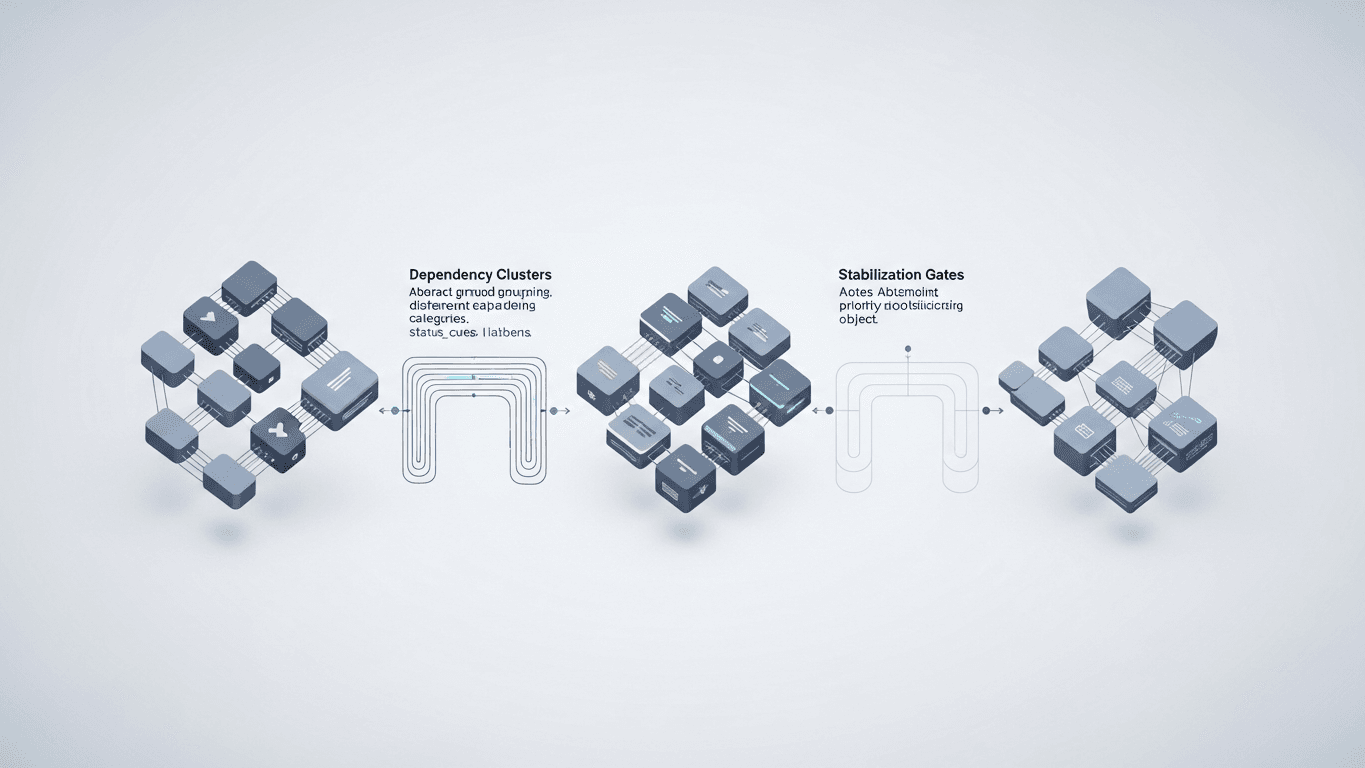
Build a dependency map before you lock order
Include physical dependencies—what must exist before the next move is safe; resource dependencies—cranes, power, utilities, tooling, skilled crews; information dependencies—routing, work instructions, MES states that must match reality; supply dependencies—inbound lanes, buffer policies, supplier change windows; organizational dependencies—training completion, shift readiness. Missing items reappear later as surprise meetings.
Stabilization gates that mean something
After each phase, require evidence of flow stability (bottleneck location stable for an agreed number of operating days), quality stability (defect spike below threshold), WIP stability (queue time not trending up at top constraints), and logistics stability (staging and dock behavior within bounds). If a gate fails, pause the next phase until the model and the floor agree again.
Scenario testing for overlap
Run scenarios that ask what happens if phase B starts late while WIP is elevated, if a shared tool outage overlaps a cutover weekend, if mix shifts during ramp because orders pull forward. The output should be a ranked list of coupling risks, not a single go date.
Risky habits versus disciplined habits
Maximizing parallel work without decoupling stacks risk; disciplined sequencing parallelizes only decoupled packages. Assuming instant stabilization skips the cost of learning; gates with measurable pass criteria do not. Hiding shared resources invites collisions; naming them in the map prevents deniability. Debating dates without shocks rehearses optimism; testing late overlap and supply delay rehearses reality.
How this shows up in gate memos and floor conversations
A useful digital twin practice creates continuity between the conference room and the walk-through. Gate memos should read like operational documents: named options, shared shocks, explicit exclusions, and the guardrails that actually bound spend. The floor conversation should echo the same language—where time accumulates, where buffers sit, what changes when inbound wobbles—so engineering detail does not get "translated" into loss on the first busy week.
Layout debates especially need this bridge. Geometry is persuasive on paper; flow is persuasive under stress. When your comparison table includes intralogistics load, constraint migration, and recovery behavior—not only headline rate—you reduce the classic failure mode where the cheapest footprint buys the most fragile Tuesday. Finance should see how timing and working capital move with those choices, not only how the capex ticket compares. That alignment is how scenario work earns a permanent seat at the table instead of a one-time consulting glow.
What DBR77 Digital Twin adds
DBR77 Digital Twin stress-tests overlap, late phases, and stabilization risk while operations keep shipping: expose coupling Gantt optimism hides; align operations, engineering, and logistics on the same stress cases; document pause triggers so execution stays governable.
Bottom line
Better sequencing is not more detail in the plan—it is fewer untested overlaps and clearer stabilization gates. Use scenario testing to earn the right to run parallel work instead of discovering coupling during the worst possible week.
DBR77 Digital Twin helps teams test sequencing and overlap risk so parallel projects do not collide on shared constraints. Book a demo or Browse use cases.
Want to see Digital Twin on your scenario?
Book a short demo — we'll show the fastest path to decision-grade outcomes.