How to Test Supplier and Ramp Risk in Factory Simulation
Build supplier and ramp scenarios deliberately
Name the decisions—layout change, new line, supplier switch, volume step-up. Inventory real failures from recent history: late days, partial shipments, quality bursts. Translate into scenario inputs as discrete delay cases or bounded bands procurement agrees are credible. Model ramp shape: weeks to stable rate, yield climb, extra touches during learning. Run paired options—baseline versus proposed—under the same supplier and ramp stresses. Record operational signals: constraint time, queue growth, overtime, missed windows, inventory spikes. If procurement will not sign a credible delay band, the organization is still guessing—with extra software.
Average plan versus risk-aware plan
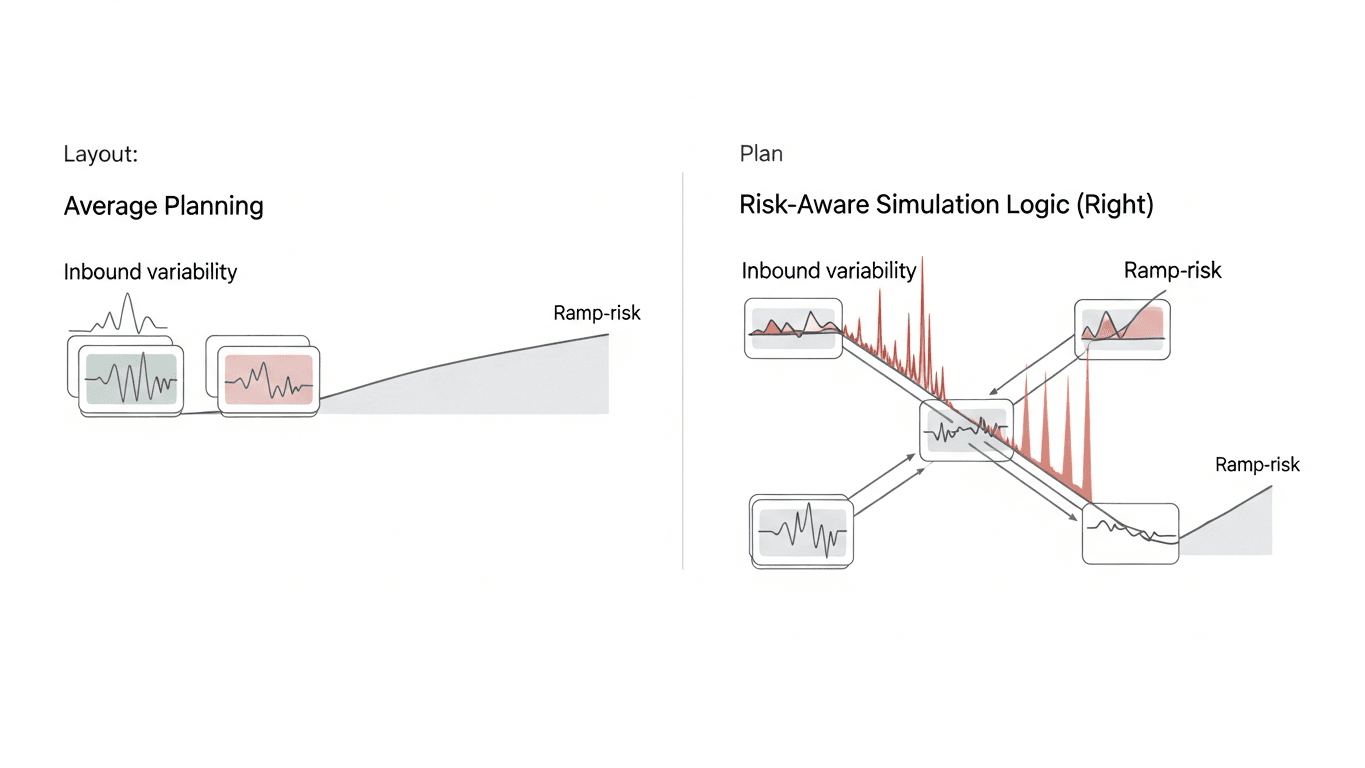
Average plans use single lead times and flat productivity. Risk-aware plans use early, on-time, and late cases with shared severities; yield curves with rework loops when relevant; ramp with overtime caps when policy matters; readouts focused on constraint time and service risk—not only average units per day.
When this works—and when it fails
It works when inbound and ramp uncertainty actually changes the ranking between options. It fails when the model cannot represent handovers between functions—supplier pain arrives as internal congestion the structure cannot see. If bands are still negotiable, tighten the input ledger using the simulation input-set article before trusting stress outputs.
Brownfield honesty: compare paths, not slogans
Brownfield factories do not reward optimism; they reward comparability. Every serious path changes something physical—travel, staging, handoffs, maintenance access—and those changes interact under real demand and supplier behavior. Scenario work earns trust when each path faces the same shocks and the same evidence rules, so the conversation stays anchored to trade-offs instead of slide charisma.
Keep the discussion explicit about what you are not doing this cycle. Exclusions are as important as favorites; they prevent zombie options from returning with a new name. When post-change refresh triggers are understood, teams stop quoting last quarter’s certainty after the floor has already moved. The twin should make that drift embarrassing quickly, which is healthier than discovering it during a service miss or an overtime weekend nobody budgeted.
Tie the story to what the floor can observe
Scenario outputs become operational when they reference behaviors people can see: where queues form, how staging fills, when overtime pressure shows up, which handoffs get brittle under mix shifts. If the narrative only speaks in abstract utilization, it will not survive first contact with a busy Tuesday. Translate the model’s language into walk-the-floor language before you ask teams to trust it.
That translation is also how finance and operations stay aligned. Cash and service effects should be traceable to those same observable behaviors, not only to a headline efficiency claim. When those links are explicit, governance gets lighter because everyone is arguing about the same mechanisms—not about competing metaphors.
What DBR77 Digital Twin adds
DBR77 Digital Twin gives procurement and operations one shock vocabulary for inbound and ramp cases, with a path from manual inputs to richer integration as data matures: consistent shock sets when comparing layouts or policies; visible propagation from inbound variability to constraints; shorter debates anchored to recent history.
Bottom line
Test the supply and learning-curve story the same way you test demand. If delays and ramps are not in the model, they will still appear on the floor.
DBR77 Digital Twin helps supply and operations align on credible delay and ramp scenarios while keeping option comparisons under the same shock set. Book a demo or Browse use cases.
Want to see Digital Twin on your scenario?
Book a short demo — we'll show the fastest path to decision-grade outcomes.