How to Turn Digital Twin Into a Repeatable CAPEX Decision System

Five reusable components
Option brief: boundaries, excluded ideas, decision date, guardrails. Stress pack: base, peak, disruption, ramp, and sensitivity rules everyone uses. Assumption ledger: bands, evidence grades, owners, dependents, change log. Gate memo: ranking, downside, kill criteria, tranche logic, next verification. Refresh charter: operational triggers that force a delta pass before the next quote of certainty.
These components are the difference between a study folder and an operating system. They are also what lets post-investment reviews find the baseline the board thought it approved.
Install the system in one quarter
Freeze templates from your strongest past project—not from a blank slide. Pilot on one real gate with explicit refusal to bypass IDs and packs. Retrofit the last two decisions into the library for credibility. Train finance and operations on reading ranges and scenario labels. Publish the operating policy where capital forums already meet. Install alongside the CAPEX stage-gate article for forum mechanics, the early option retirement article for kill discipline, and the assumption ledger article for cross-project IDs.
Pick a gate that matters enough to hurt if it slips; convenience pilots teach the wrong habits.
You have a system—not a project
New CAPEX threads start with a scenario library fork—not new folder chaos. Post-investment reviews can find baseline scenario IDs. Killed options stay archived with failure notes. Integration depth matches cadence per your data linkage policy.
One-off study culture versus system culture
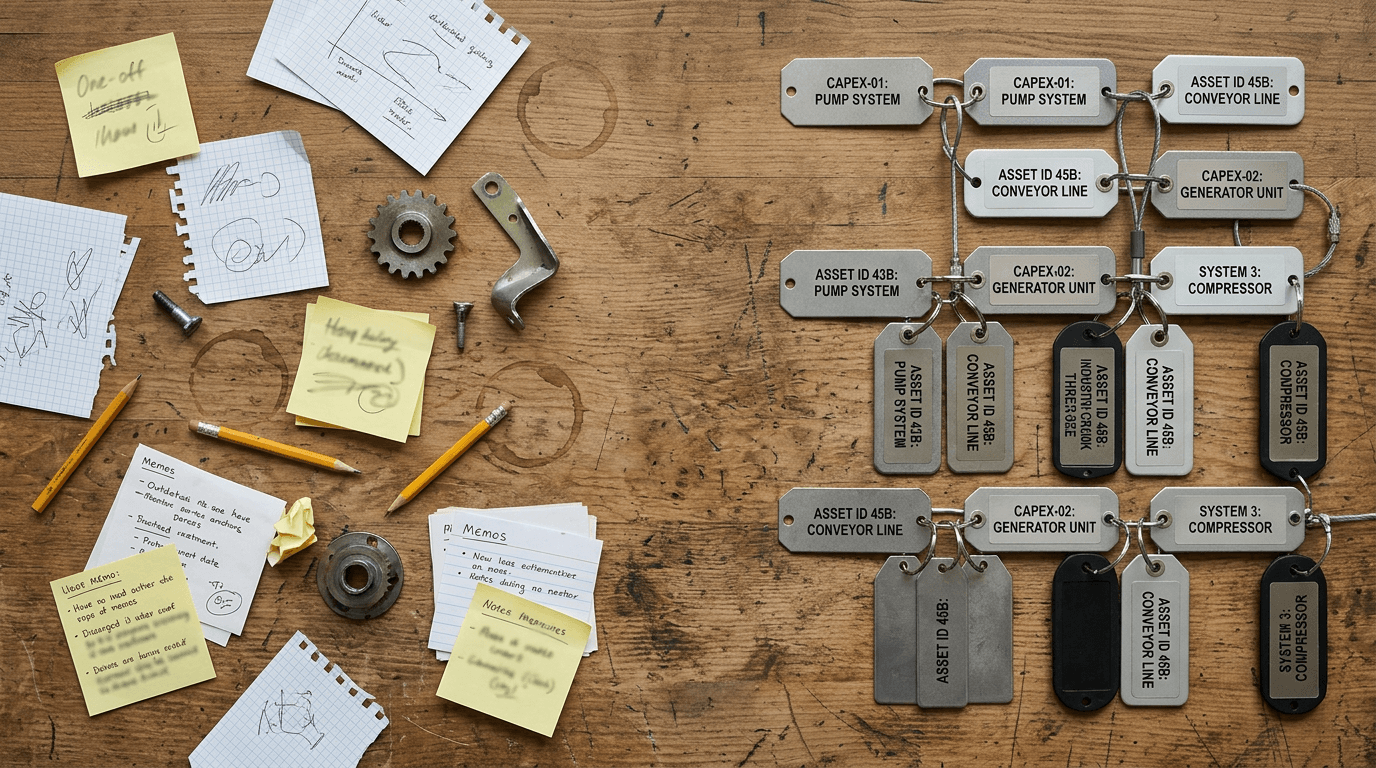
One-off studies start from blank decks and hero charts; learning lives in personal memory; refresh is optional. System culture forks library and ledger, publishes ranked ranges with IDs, compounds learning in shared templates, and triggers refresh with dates.
Layout and governance consequences
When the system is real, layout debates attach to the same stress pack as finance debates. That alignment is what keeps CAPEX from oscillating between engineering optimism and spreadsheet pessimism without a shared middle layer.
From comparison to commitment
Simulation quality is not measured by how polished the scene looks; it is measured by whether a responsible executive can commit with a downside story they are willing to own. That requires frozen option sets, honest ranges, and stress paths that include the weeks nobody wants on a chart. It also requires a written trigger for partial reruns when scope shifts before spend lands.
If your organization struggles here, the fix is usually social, not technical: name the standard pack, refuse bespoke optimism per option, and publish kill notes when paths fail. Carry fewer, stronger scenarios into execution. The factory will still be hard; the difference is that you rehearsed the hard parts before concrete hardened them.
What DBR77 Digital Twin adds
DBR77 Digital Twin becomes shared templates, stress packs, and ledgers inside the capital forum instead of a one-off study folder per project—with a clear path from manual inputs to richer integration when cadence demands it.
Bottom line
If every CAPEX cycle feels new, you are paying tuition forever. Standardize the decision machinery once, then improve it with evidence.
DBR77 Digital Twin supports the scenario comparison layer inside a standardized CAPEX operating pattern from manual inputs to deeper integration. Book a demo or Explore Digital Twin.
Want to see Digital Twin on your scenario?
Book a short demo — we'll show the fastest path to decision-grade outcomes.