How to Use Digital Twin for Brownfield Change Planning

Separate plan ownership from behavioral proof
The project plan owns scope, milestones, and resource calendars; the twin tests temporary flow logic in detail, bottleneck migration during phases, and service risk under variability. When the twin is absent, coupling risk stays implicit until the floor enforces it.
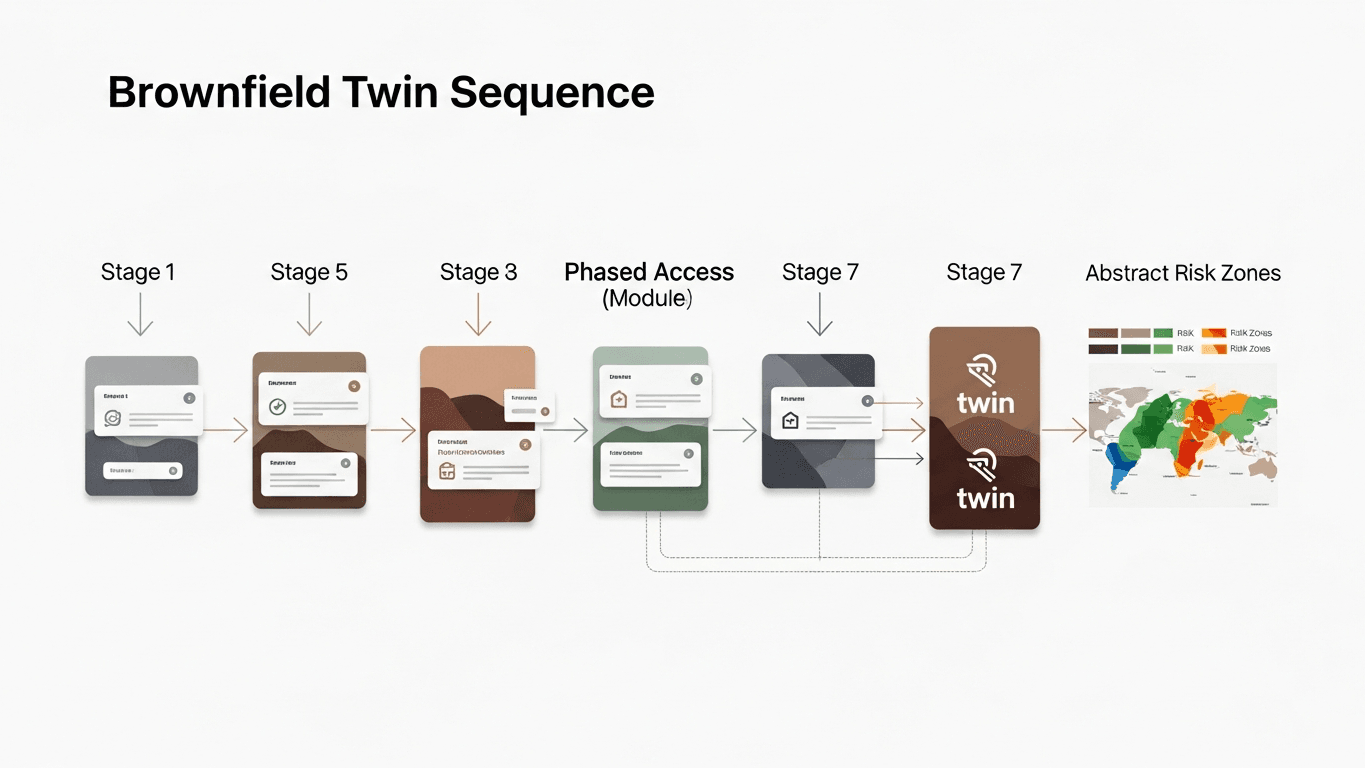
A disciplined sequence
Freeze the decision sentence: what physical state must exist after each phase. Build a credible baseline from recent weeks that include pain, not only smooth operation. Encode hard constraints—access limits, parallel projects, staffing minimums, tool sharing. Model each phase as a scenario with honest ramp and recovery. Add rollback or hold points where the site can stabilize if reality diverges. Run stress cases on the worst credible mix and inbound disruption for each phase. Publish a one-page risk map: what breaks first, which KPI signals trigger a pause. That is how engineering and operations share one operational truth.
Minimum inputs for trust
Include routings and precedence that match how work really moves, including exceptions; changeover and setup reality including worst-family behavior; material handling paths for normal and restricted configurations; labor rules for skills, coverage, and overtime caps the site actually follows; maintenance and quality windows as calendar effects, not long-run averages. Politically smoothed inputs produce politely wrong outputs.
Render versus sequence risk
Teams sometimes chase a pretty layout animation while the schedule assumes instant stability. A useful brownfield twin produces queue growth signals during restricted access, sensitivity to a delayed handoff, and where temporary bottlenecks concentrate WIP. Without those outputs, the twin is decoration.
Executive discipline without slowing the line
The goal is not more meetings; it is fewer surprises. A disciplined twin rhythm means the expensive conversations happen early, when options are cheap, and the later forums validate decisions that already survived a standard pack. Executives should experience simulation as a narrowing machine: it retires weak paths with evidence, clarifies what must be verified before cash moves, and forces owners to name what would invalidate the plan.
Treat sensitivity and stress as part of capital hygiene, not as a specialist hobby. If a ranking flips under plausible bands, leadership should see that flip before signatures land—otherwise the organization discovers it during ramp. If a ranking is stable but fragile under disruption stories, that fragility belongs in the memo as a managed risk, not as a private worry for operations. Digital twin is strongest when it makes those tensions visible while you still have room to sequence work, stage cutovers, or adjust buffers without heroics.
What DBR77 Digital Twin adds
DBR77 Digital Twin anchors brownfield programs where partial access and concurrent work make plans and floor behavior drift apart: align project and operations on the same constraint story; test cutover sequences under variability; reduce the odds of learning coupling during a shutdown window. For sequencing beyond program planning, pair with the article on sequencing factory changes with less operational risk.
Bottom line
Brownfield planning needs more than dates. It needs behavior under partial access and concurrent work. Use digital twin to sequence changes with explicit stress cases and pause triggers so modernization inherits less chaos from untested assumptions.
DBR77 Digital Twin helps brownfield programs compare staging and sequencing options under real constraints before shutdown windows become irreversible commitments. Book a demo or Browse use cases.
Want to see Digital Twin on your scenario?
Book a short demo — we'll show the fastest path to decision-grade outcomes.