The Cost of Rework When You Skip Scenario Testing

Testing is usually cheaper than correction
Comparing variants before physical change can feel like extra work. In practice it is frequently the cheaper path because it exposes whether layout behaves as expected, whether throughput gain is real, whether constraints create side effects, and whether the chosen option remains strong under variation. Discovering weakness in a model is inexpensive. Discovering it after spend is not.
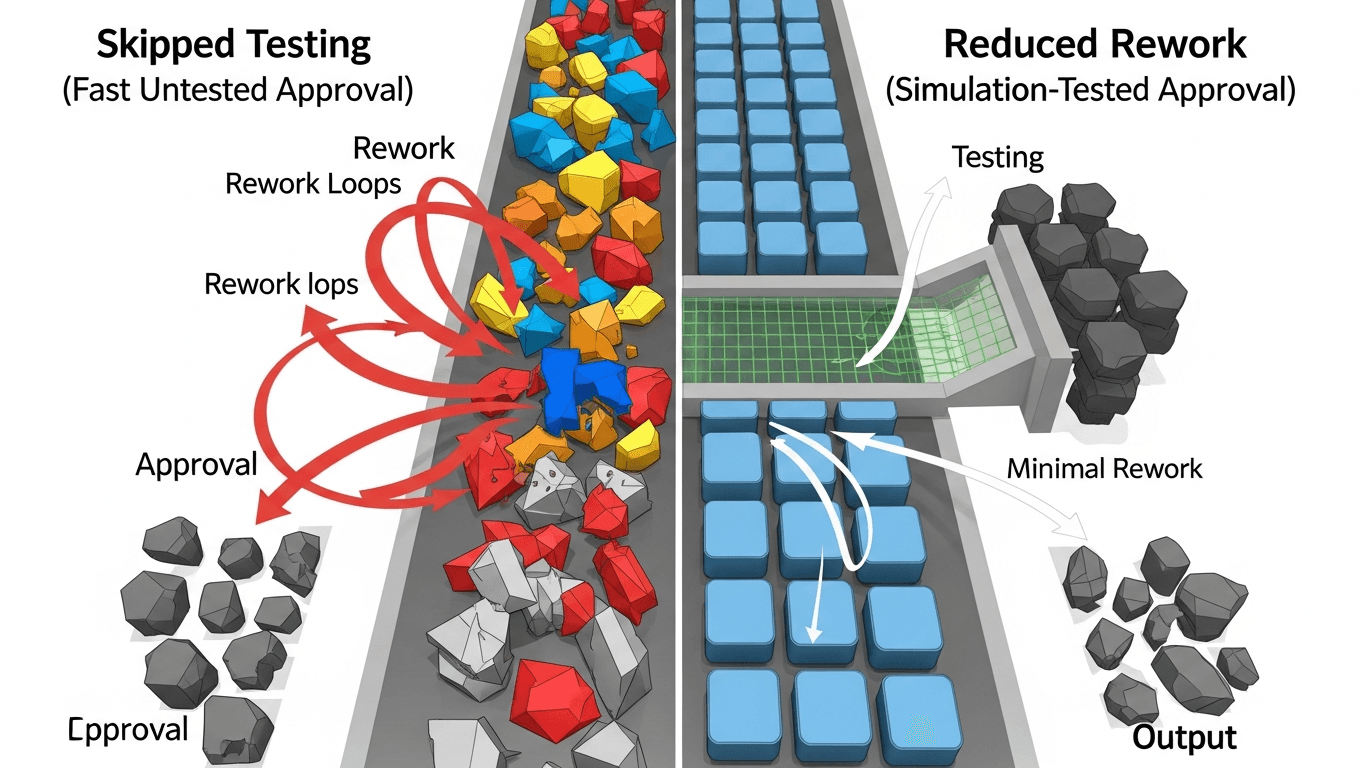
Fragmented costs hide the truth
Organizations underestimate rework because the bill fragments: redesign effort, delayed launch, lower-than-expected output, management realignment, extra vendor work. No single budget line captures the whole story. The organization still pays—in cash, time, and attention.
False speed
Skipping scenario testing is often framed as speed. Speed without sufficient validation frequently produces the slower outcome: the project accelerates through approval, then loses time to correction, stabilization, conflict resolution, and unexpected downstream issues. That is not fast execution. It is deferred friction with interest.
Confidence and culture
The cost is not only financial. Rework erodes stakeholder trust, weakens confidence in future cases, and poisons belief in the original decision process. The next investment becomes harder to align even when it is stronger on paper. Scenario discipline is therefore cultural infrastructure, not a modeling hobby.
What should feel different on Monday
Teams rarely fail because they lack intelligence; they fail because the next meeting repeats the same questions with fresher anxiety. When simulation work is wired into how you decide, Monday shows up with fewer circular arguments about whether a layout "ought to work." Instead, you carry a short list: which option survived the same stress vocabulary, which assumptions still carry hypothesis labels, and what would force you to rerun the pack before the next tranche. That is the practical face of governance—not a heavier process, but a clearer receipt for why the floor should trust the plan.
For capital and footprint choices, the receipt matters as much as the ranking. Approvals should be able to point to scenario identity and ranges without opening a model. If executives cannot explain the downside story in plain language, the organization is still buying animation. If operations cannot recognize the staffing and flow assumptions embedded in the memo, the twin is still a slide, not a decision system. Use the next leadership block to test whether the narrative is portable: could someone not in the room defend the choice from the packet alone? If not, tighten the assumption ledger and the executive summary before you ask for more money or more floor space.
What DBR77 Digital Twin changes
DBR77 Digital Twin helps organizations reduce rework by testing decisions before physical change begins: scenario comparison, simulation under realistic deviations, progressive data maturity, and human-approved decisions. Uncertainty moves forward into a controlled decision stage instead of backward into physical correction.
Bottom line
The cost of skipping scenario testing is much larger than redesign alone. It includes delay, weaker output, management drag, and lower confidence in the decision path. Scenario testing should not be treated as optional analysis. It is one of the cheapest ways to avoid expensive learning in reality.
DBR77 Digital Twin reduces rework risk by moving uncertainty into scenario testing before physical change begins. Book a demo or Browse use cases.
Want to see Digital Twin on your scenario?
Book a short demo — we'll show the fastest path to decision-grade outcomes.