The ROI of Digital Twin in 12 Months

ROI follows decisions, not existence
Digital twin does not create value by occupying a server. It creates value when it improves decisions that would otherwise produce rework, delay, underused investment, or hidden flow waste. The right ROI question is not how impressive the model looks but which costly decision it improves first.
Where early return usually concentrates
Fast impact typically comes from focused use cases: testing a layout change before implementation, validating a CAPEX case before approval, surfacing a hidden bottleneck before it spreads, comparing workforce or flow variants before rollout. These decisions sit close to expensive reality, which is why they can produce early economic effect.
How return shows up
The return often appears as avoided redesign, faster alignment on better options, reduced rollout risk, stronger utilization of approved investments, and fewer costly surprises after change. It may not map cleanly to one line item; the organization still feels it in economics and decision speed.
Why some programs struggle to prove value
Programs stall when they start too broad, too abstract, or too disconnected from a real decision: twin as showcase, perfect data as prerequisite, modeling too much before solving one business-critical choice. That delays proof and feeds the myth that value is always distant.
Progressive path
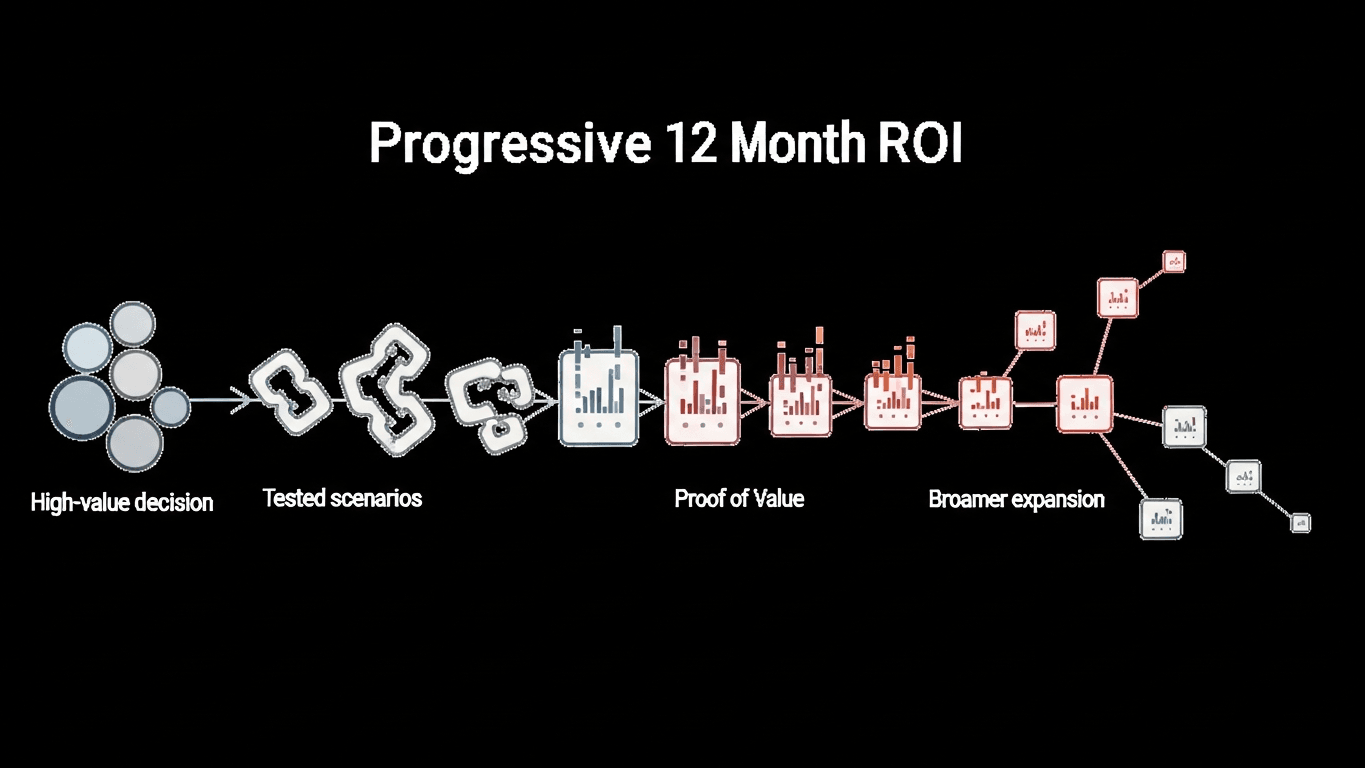
A twelve-month ROI path typically looks like this: start with one high-value decision, use manual or historical inputs where enough, test scenarios that affect cost, throughput, or risk, prove value, then expand. Economic credibility does not require a giant first leap.
Finance and operations both need to see it
Finance looks for payback, risk reduction, and capital discipline. Operations looks for flow stability, fewer surprises, and stronger change decisions. ROI is durable when both sides can point to what decision improved, what risk was avoided, and what cost or delay was reduced.
Executive discipline without slowing the line
The goal is not more meetings; it is fewer surprises. A disciplined twin rhythm means the expensive conversations happen early, when options are cheap, and the later forums validate decisions that already survived a standard pack. Executives should experience simulation as a narrowing machine: it retires weak paths with evidence, clarifies what must be verified before cash moves, and forces owners to name what would invalidate the plan.
Treat sensitivity and stress as part of capital hygiene, not as a specialist hobby. If a ranking flips under plausible bands, leadership should see that flip before signatures land—otherwise the organization discovers it during ramp. If a ranking is stable but fragile under disruption stories, that fragility belongs in the memo as a managed risk, not as a private worry for operations. Digital twin is strongest when it makes those tensions visible while you still have room to sequence work, stage cutovers, or adjust buffers without heroics.
What DBR77 Digital Twin adds
DBR77 Digital Twin is structured so year-one ROI appears where capital and operations already feel pain: paired scenarios, downside visibility, faster alignment on fewer better options. Progressive inputs so mid-year value does not wait for a perfect data foundation; outputs leadership can tie to specific decisions in quarterly reviews. Use the business-case article for the full approval storyline; use this article when finance asks what the first twelve months actually prove.
Bottom line
The ROI of digital twin in twelve months is real when the twin improves expensive decisions early—not when it is treated as a broad innovation showcase. That is how it moves from strategic promise to measurable business value.
DBR77 Digital Twin helps organizations prove ROI earlier by improving expensive decisions around layout, flow, bottlenecks, and CAPEX risk. Book a demo or Browse use cases.
Want to see Digital Twin on your scenario?
Book a short demo — we'll show the fastest path to decision-grade outcomes.