Why CAPEX Decisions Should Be Simulated Before They Are Approved

Where approval goes wrong
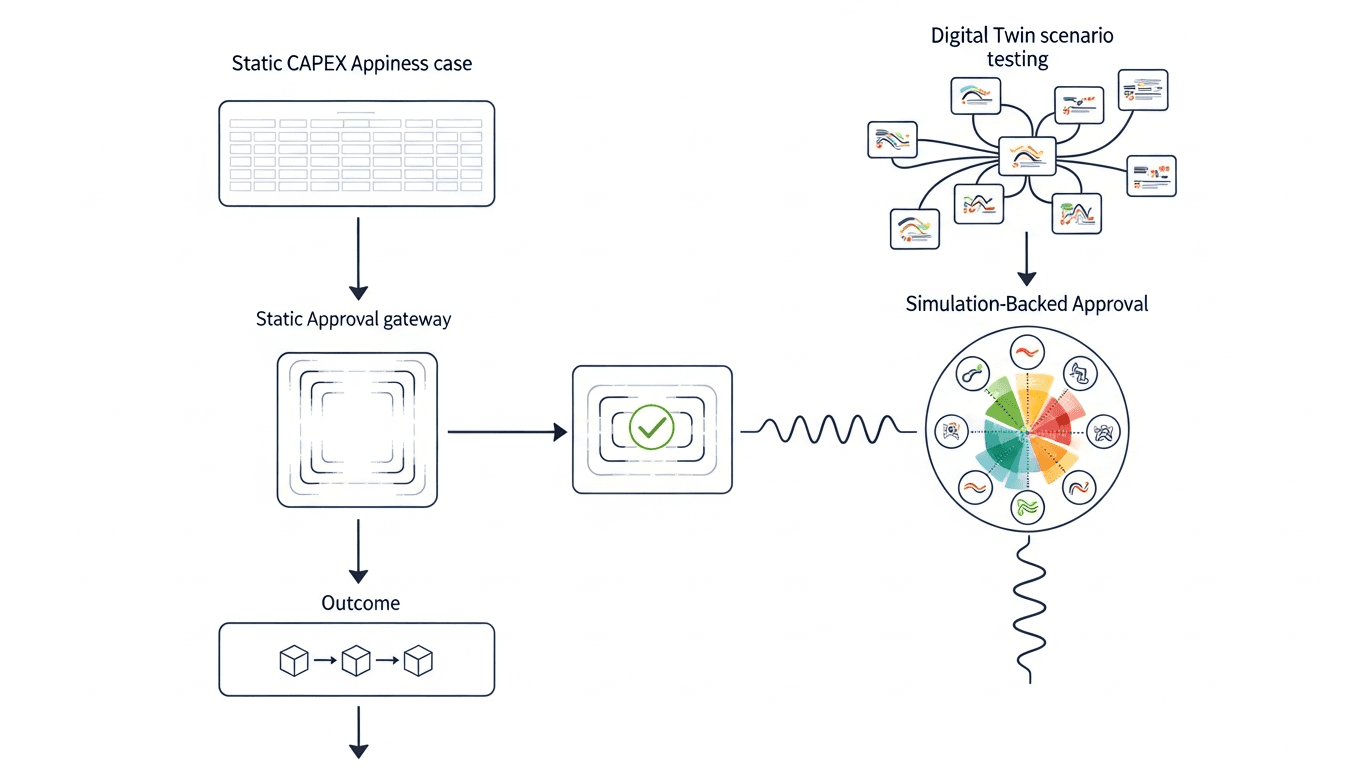
In many organizations, CAPEX still moves through static ROI models, presentation assumptions, partial layout understanding, and incomplete operational context. That does not imply carelessness. It usually means the decision frame is narrower than the system being funded. Capital allocation under complexity needs more than a single expected outcome; it needs visibility into how fragile that outcome is when the plant behaves like a plant.
What a strong case must survive
A trustworthy CAPEX narrative should answer questions finance and operations can ask together: what happens if variability increases? what happens if flow or routing shifts? what happens if a buffer policy changes? what happens if staffing or sequencing behaves differently than the slide assumed? If the economics swing sharply under realistic scenarios, that is not noise—it is exactly the signal leadership needs before signing.
False confidence and its bill
One of the largest risks in CAPEX is confidence built on unstressed assumptions. Simulation reveals hidden bottlenecks, layout constraints, throughput trade-offs, and downstream side effects. The point is not to slow decisions for sport. The point is to make weak decisions harder to approve without debate. Speed without validation often becomes the slower path once rework, underused assets, and stabilization drag appear.
The cost of skipping the test
When approval outruns scenario discipline, costs fragment across redesign, delayed launch, weaker output, extended stabilization, and internal debate about what was missed. None of that appears as a single line item, which is why organizations underestimate it. Treating simulation as optional analysis is treating rework as the default learning mechanism.
You do not need perfect live data to start
A common stall is the belief that simulation only matters after full integration maturity. Decision-grade work can begin with manual inputs, historical traces, realistic ranges, and honest process logic. Live data enriches the model over time; the first win is often disciplined scenario thinking and shared assumptions, not perfect connectivity.
Why this matters at the top
CAPEX is capital allocation under uncertainty. Leadership needs downside visibility, scenario confidence, clear trade-off logic, and faster alignment across functions. Simulation converts opinion-heavy investment debate into something closer to decision engineering—comparable options, comparable shocks, comparable interpretation.
What DBR77 Digital Twin changes
DBR77 Digital Twin is built for this stage of decision-making. Its value is not only visualization. It is scenario comparison, deviation-aware simulation, progressive data maturity, and human-approved decision support—useful before physical changes begin, when decision quality matters most.
Bottom line
CAPEX should be simulated before approval because approval should rest on tested operational reality, not only on static assumptions. That does not remove uncertainty; it makes uncertainty visible early enough to govern. That is what better capital decisions require.
DBR77 Digital Twin helps leadership test investment scenarios, compare trade-offs, and reduce CAPEX risk before committing to physical changes. Book a demo or Browse use cases.
Want to see Digital Twin on your scenario?
Book a short demo — we'll show the fastest path to decision-grade outcomes.