Why Most Digital Twins Fail

Over-scoping and the loss of learning
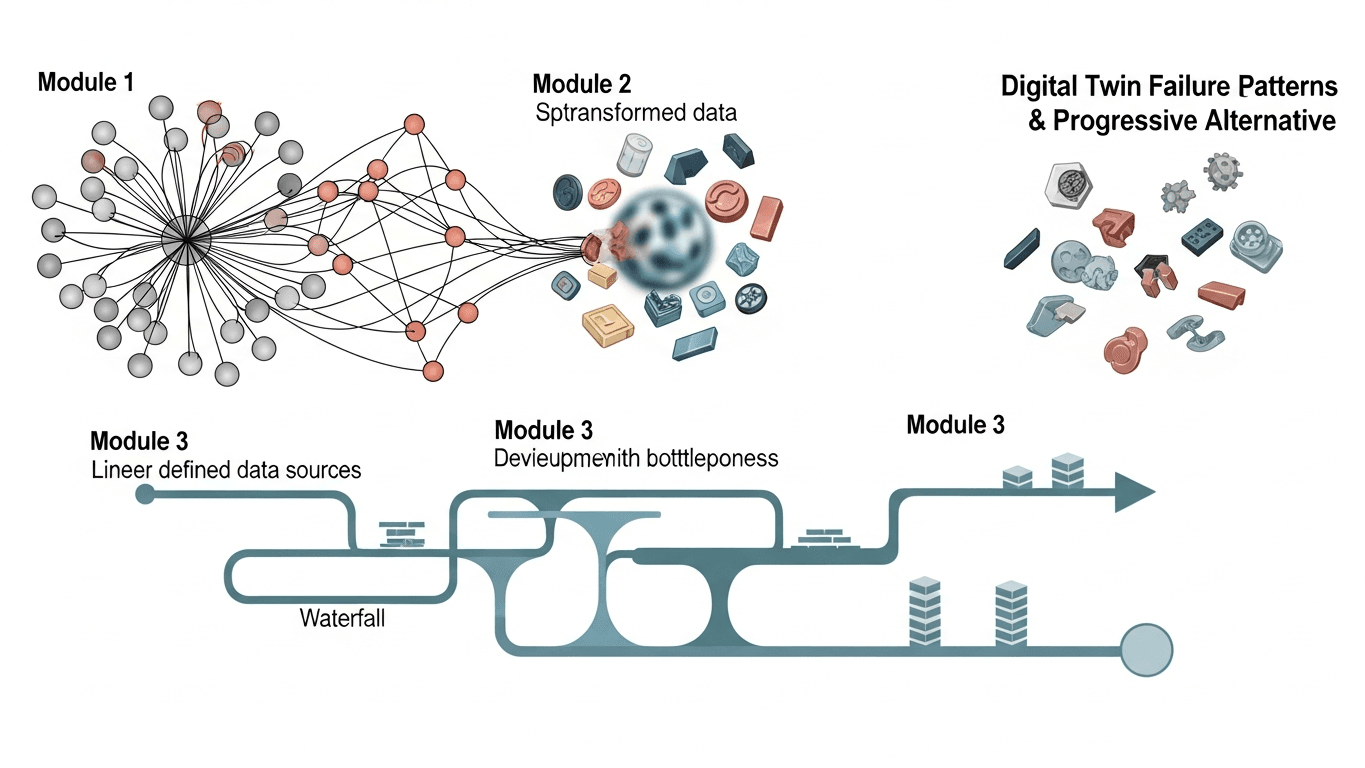
Another common pattern is starting too big: too much of the plant, too many edge cases, too many integrations at once. Big-bang ambition produces slow delivery, fragile complexity, and weak learning loops. A twin should begin where scenario value is clearest, not where ambition is loudest. Small, comparable runs beat a monument that never reaches a gate.
Visual strength without decision logic
A project can look impressive and still fail commercially when outputs are visually strong but operationally thin. If the twin does not help teams compare variants, test trade-offs, reduce uncertainty, or support real approvals, it remains a presentation layer. The failure mode is not aesthetics. It is missing comparative discipline tied to consequences leadership recognizes.
Perfect data as a permanent deferral
Many teams delay useful work because they believe value starts only after full live integration. A twin can begin with manual inputs, process logic, historical traces, and calibrated assumptions. Waiting for perfect data maturity often means missing the decision window the twin was meant to improve. Progressive maturity is a feature, not an apology.
Adoption follows decision relevance
A twin becomes sticky when it helps a real decision-maker do something measurably better. If the CFO cannot validate CAPEX faster, if the COO cannot compare scenarios with confidence, or if engineering cannot test layout variants before spend, the twin drifts toward optional. The issue is not only technical fit. It is whether the workflow around the model produces an artifact approvals actually use.
Workflow, not wizardry
Some initiatives underperform not because the simulation is poor, but because the workflow is weak: no clear approval logic, no repeatable scenario process, no shared interpretation of results, no path from output to action. Digital twin work should be treated as part of decision workflow—not as an isolated technical artifact admired on a tour.
How this shows up in gate memos and floor conversations
A useful digital twin practice creates continuity between the conference room and the walk-through. Gate memos should read like operational documents: named options, shared shocks, explicit exclusions, and the guardrails that actually bound spend. The floor conversation should echo the same language—where time accumulates, where buffers sit, what changes when inbound wobbles—so engineering detail does not get "translated" into loss on the first busy week.
Layout debates especially need this bridge. Geometry is persuasive on paper; flow is persuasive under stress. When your comparison table includes intralogistics load, constraint migration, and recovery behavior—not only headline rate—you reduce the classic failure mode where the cheapest footprint buys the most fragile Tuesday. Finance should see how timing and working capital move with those choices, not only how the capex ticket compares. That alignment is how scenario work earns a permanent seat at the table instead of a one-time consulting glow.
What DBR77 does differently
DBR77 Digital Twin is positioned around decision-grade outcomes, progressive data maturity, and human-approved decisions. That orientation avoids three common traps: visualization-first thinking, big-bang scope, and perfect-data dependency. It starts from practical scenario testing and scales as the organization gains confidence.
Bottom line
Most digital twins fail because the project is not tied tightly enough to a real decision, a manageable scope, and a usable workflow. When those elements align, the twin stops being a showcase and becomes operational infrastructure for better judgment.
DBR77 Digital Twin starts from practical scenario decisions, progressive data maturity, and human-approved workflows instead of visualization-first or perfect-data-first thinking. Book a demo or Browse use cases.
Want to see Digital Twin on your scenario?
Book a short demo — we'll show the fastest path to decision-grade outcomes.