Stop material shortages from becoming your #1 downtime driver.
Simulate replenishment and routes on your layout and production plan, then compare variants when constraints change.
Why this matters
Typical pains
A clear view of what breaks in the real world, so the model is built for what actually happens.
Material shortages are a top driver of lost output.
Static schedules break when shared machines and shortages meet.
Paths and buffers are optimized locally, not end-to-end.
Outcomes
What improves
A measurable way to evaluate scenario variants and the decisions you will make.
Stops due to material
down
Transport distance
compared by scenario
WIP & buffers
compared by variant
Deliverables
What you get
A decision-ready package: model, scenarios, and an actionable rollout path.
Deliverables
- Replenishment variants compared on the production plan
- Transport routes tested against the actual layout constraints
- Simulation of the week with transport, buffers and shifts
Recommended capabilities
Start with the minimum set needed for the outcome, then add more data as the use-case matures.
Proof
Case studies
Real scenarios, shown in full under this use case.
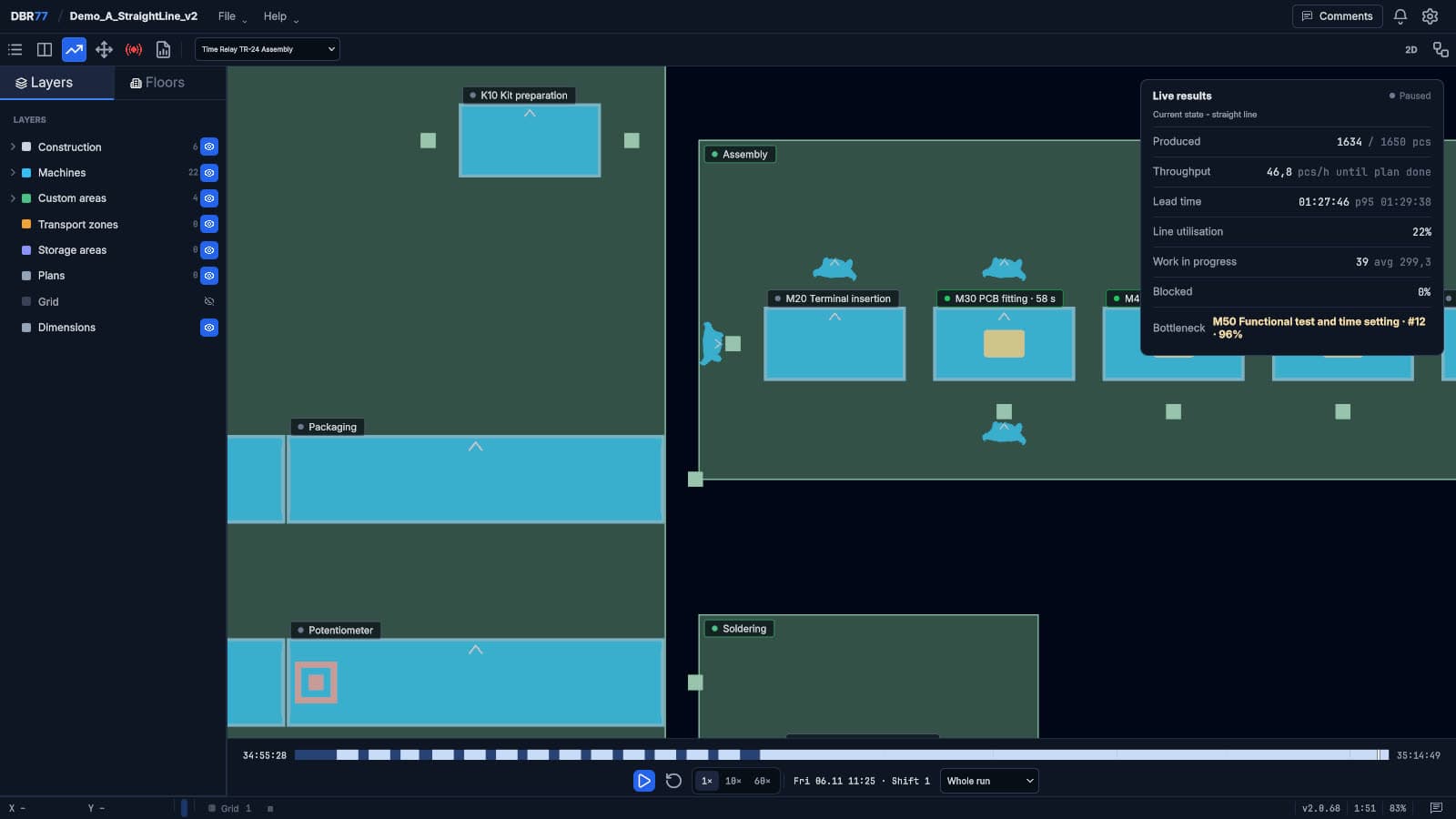
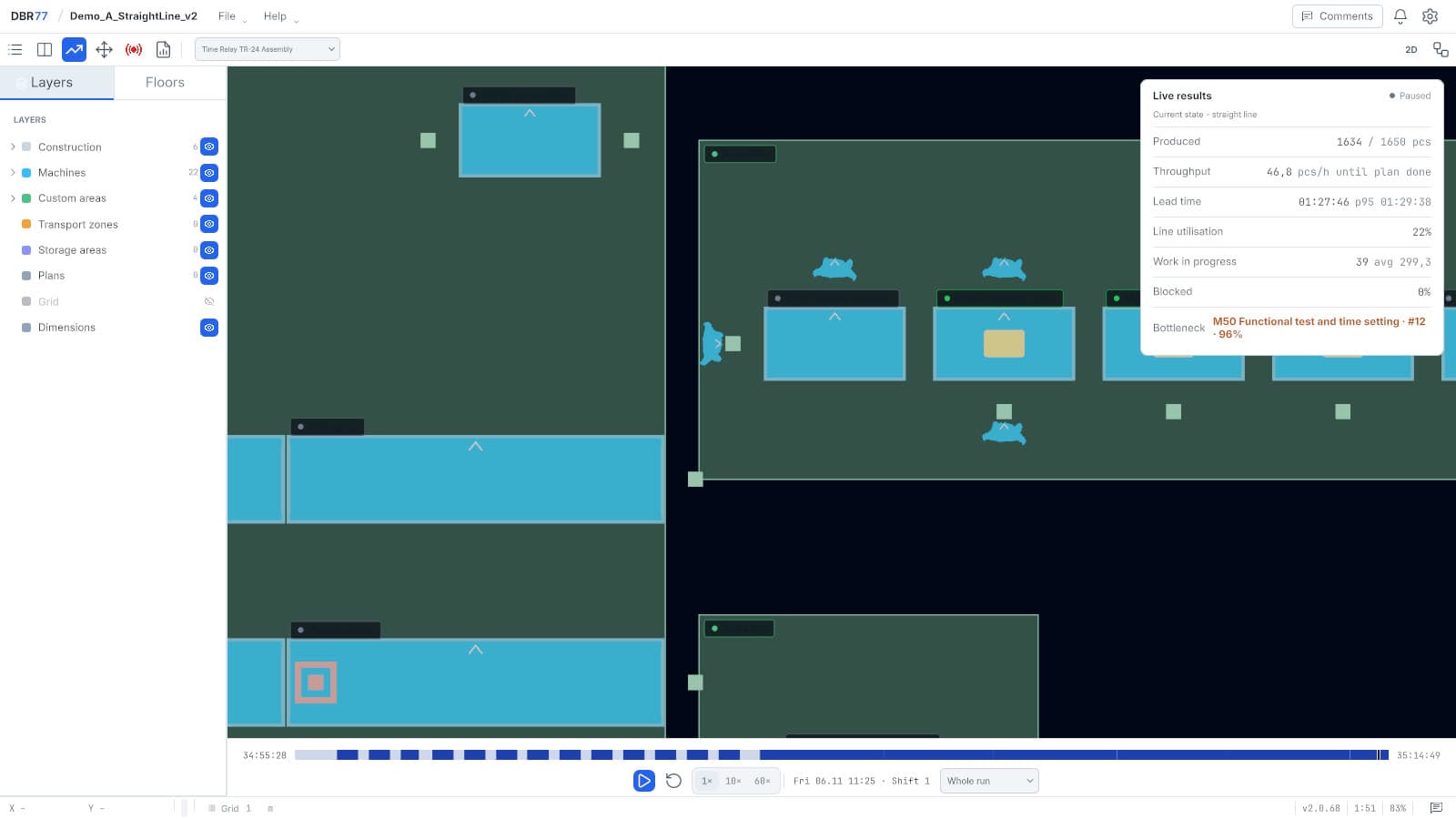
Plastic injection molding for household appliances, central Poland
Automation concept: an autonomous cart at the bottleneck
Context
A plant with over 200 people on three shifts. Its processes are injection molding, extrusion, thermoforming, assembly, packaging, quality control and packing. The facility has 20,000 m² and the warehouse 8,000 m².
Task
Analyze the options to automate and robotize several stations on a line. The analysis covered technical feasibility and the throughput and productivity of the target automated line, with an economic analysis of each option.
Work
- Built a digital twin of the selected part of the plant, with material flows and the process times of each task.
- Selected the tasks with the greatest process, economic and ergonomic weight for automation.
- Prepared alternative automation scenarios.
- In the next iteration, added a simulation of automatic transport between stations.
- Prepared efficiency, productivity and working time reports for every variant.
Results
- The analysis found options to automate intralogistics, including non-ergonomic tasks, and quality control.
- The bottleneck was a manual process at the first operator: 90 seconds of work and 98 seconds of waiting.
- Replacing the operator with an autonomous cart raised efficiency by over 100% and set the conditions for the investment to pay off.
Benefits
- A variant analysis of the selected area.
- An informed operational and financial decision on automation.
- With the target transport concept ready, the company selected a technology provider on DBR77 Marketplace.
Next step
Have a decision to test?
Describe your layout and the decision you are weighing. A DBR77 expert will show you how to test it on the digital twin, starting from the data you have.
Sign in or sign up at studio.dbr77.ai.