Optimize picks, paths, and layout before you expand.
Simulate warehouse operations to find bottlenecks, validate slotting, and compare process rules.
Why this matters
Typical pains
A clear view of what breaks in the real world, so the model is built for what actually happens.
Peak weeks break the system and SLAs.
Slotting decisions are made without scenario testing.
Plans don’t reflect real paths, queues and shared resources.
Outcomes
What improves
A measurable way to evaluate scenario variants and the decisions you will make.
Throughput
increased without expansion
SLA risk
lower via scenario planning
Utilisation
visible by station and vehicle
Deliverables
What you get
A decision-ready package: model, scenarios, and an actionable rollout path.
Deliverables
- Warehouse scene and process model
- Variant simulations
- Bottleneck identification and actions
Recommended capabilities
Start with the minimum set needed for the outcome, then add more data as the use-case matures.
Proof
Case studies
Real scenarios, shown in full under this use case.
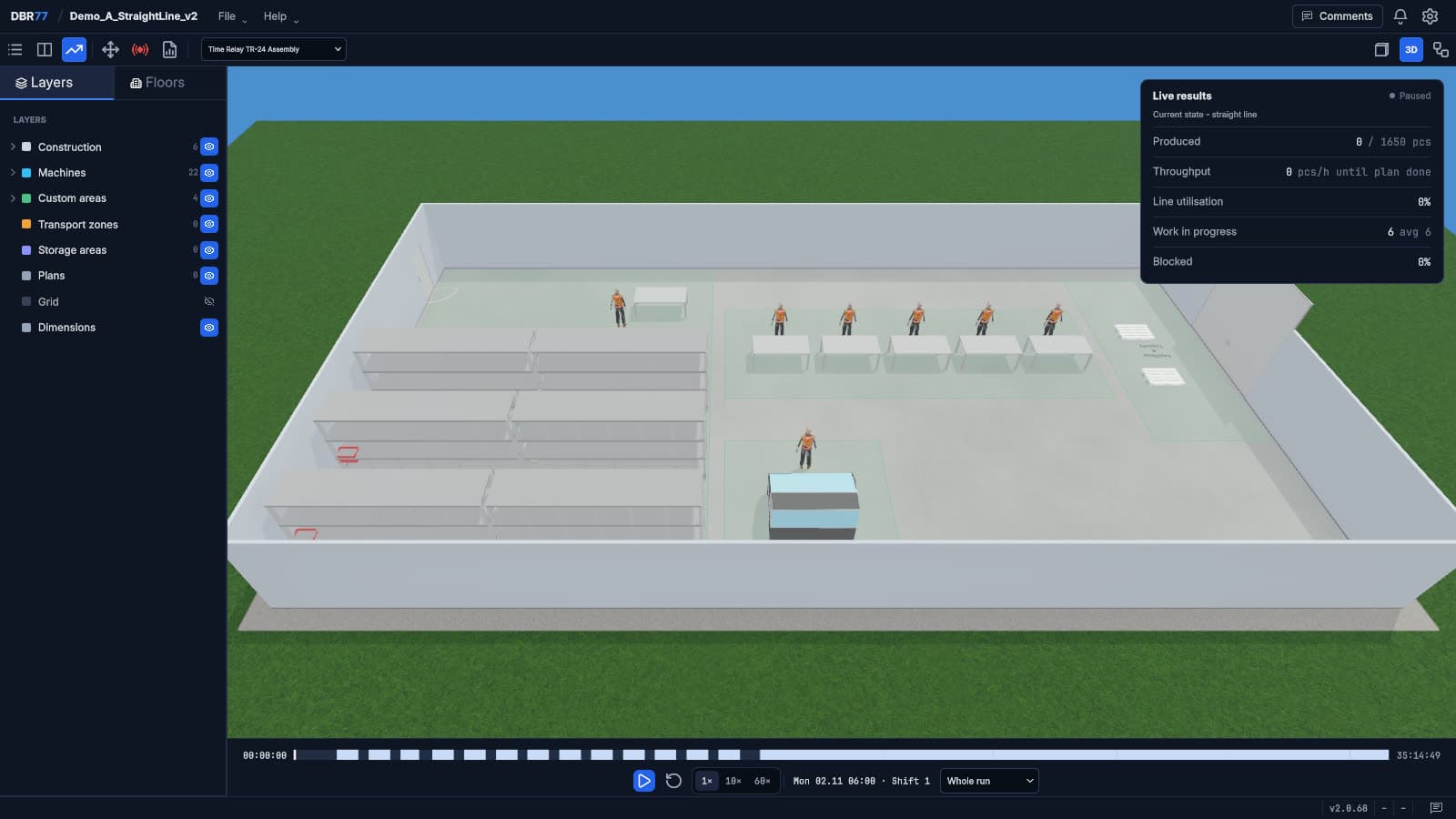
Ventilation and cooling equipment manufacturer, Mazovia, Poland
Material retrieval from the warehouse: up to 60% less time
Context
A plant with over 150 people on two shifts. The products are highly customized, which makes picking complex. The warehouse makes on average 800 picks per shift, and 10 people work in the analyzed picking area.
Task
Generate the pick list dynamically for the product mix planned for each day. The customer used warehouse picking simulations in the digital twin.
Work
- Built a digital twin of the warehouse section.
- Defined the transport routes and the boundary conditions of picking.
- Set the operating parameters and the means of transport used for picking.
- Prepared the process data structure and imported the data.
- Chose the algorithm for the task and generated the best pick list.
Results
- Three states were simulated: picking in the order of the production orders, without optimization (1,000 s), with an island algorithm (550 s) and with a sorting algorithm (200 s).
- The case study reports that the optimization can reduce the time of the original process by up to 60%.
Benefits
- The picking simulation covered the current production orders.
- After a change in the plan, the updated production order is imported and the algorithm finds the new pick list in seconds.
- This matters when materials or operators are missing and production has to change.
Next step
Have a decision to test?
Describe your layout and the decision you are weighing. A DBR77 expert will show you how to test it on the digital twin, starting from the data you have.
Sign in or sign up at studio.dbr77.ai.